Category Archives: Uncategorized

Second Avenue Snow

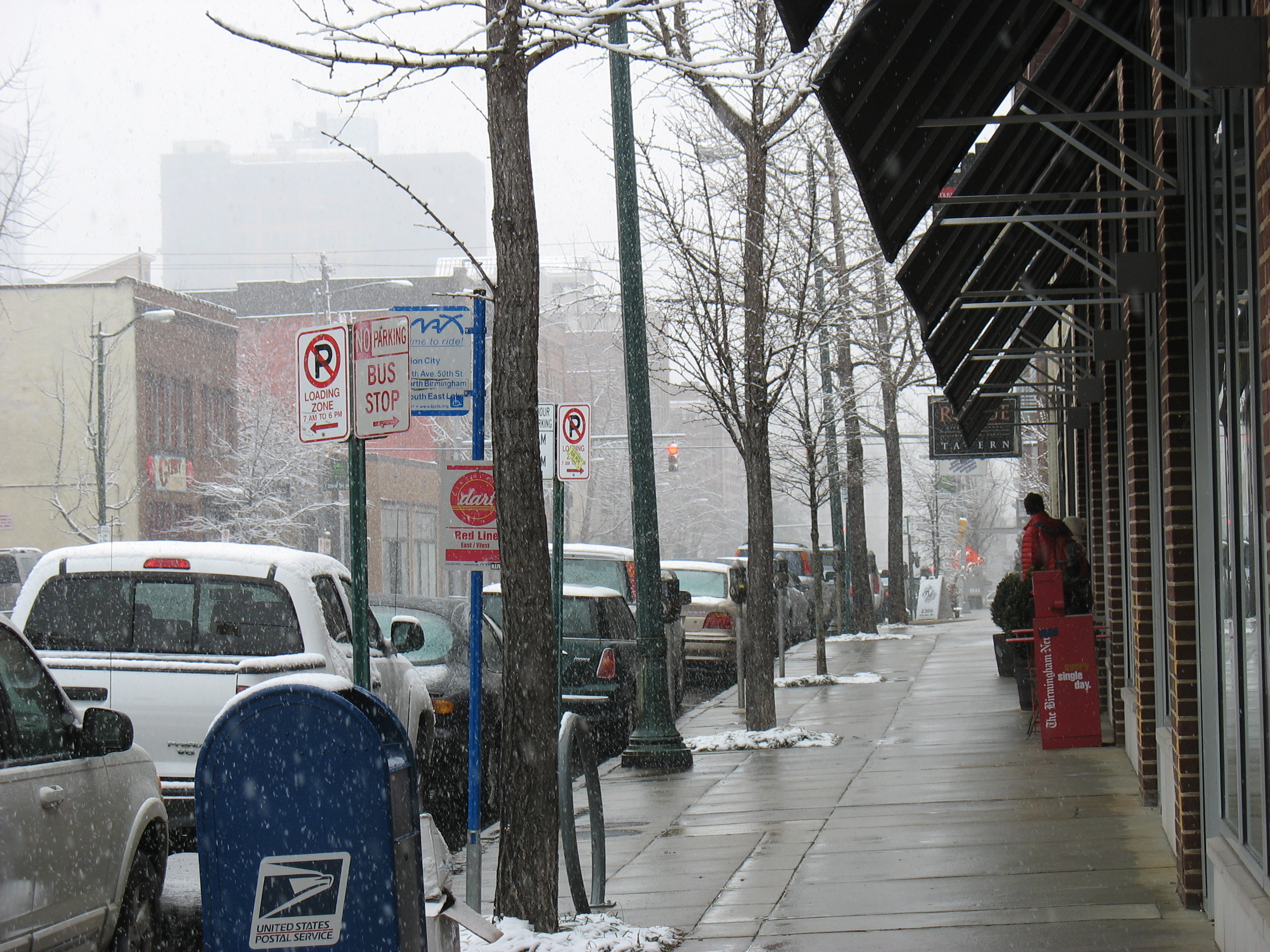
Since I live next door to the office–with no excuse to leave early for a “snow day”, I thought I’d at least record the scene outside. A normally active sidewalk is fairly deserted.

I would also encourage everyone to check out another new blog about Birmingham’s built environment, inter-woven with historical context:  http://www.heaviestcorner.org/

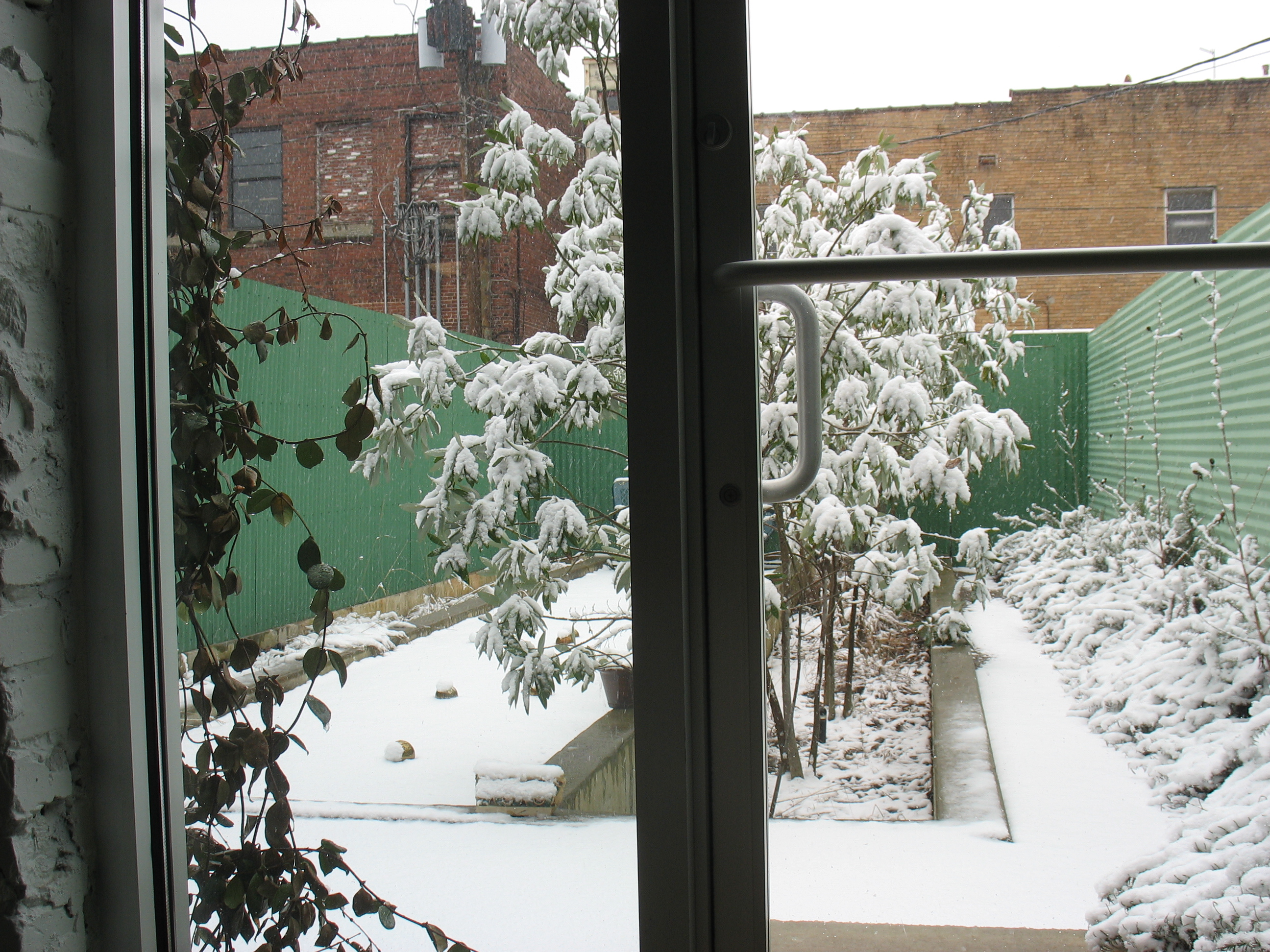
And finally for today’s short, snowy post, the view from my living room out to the small urban garden:

School Dazed … and confused

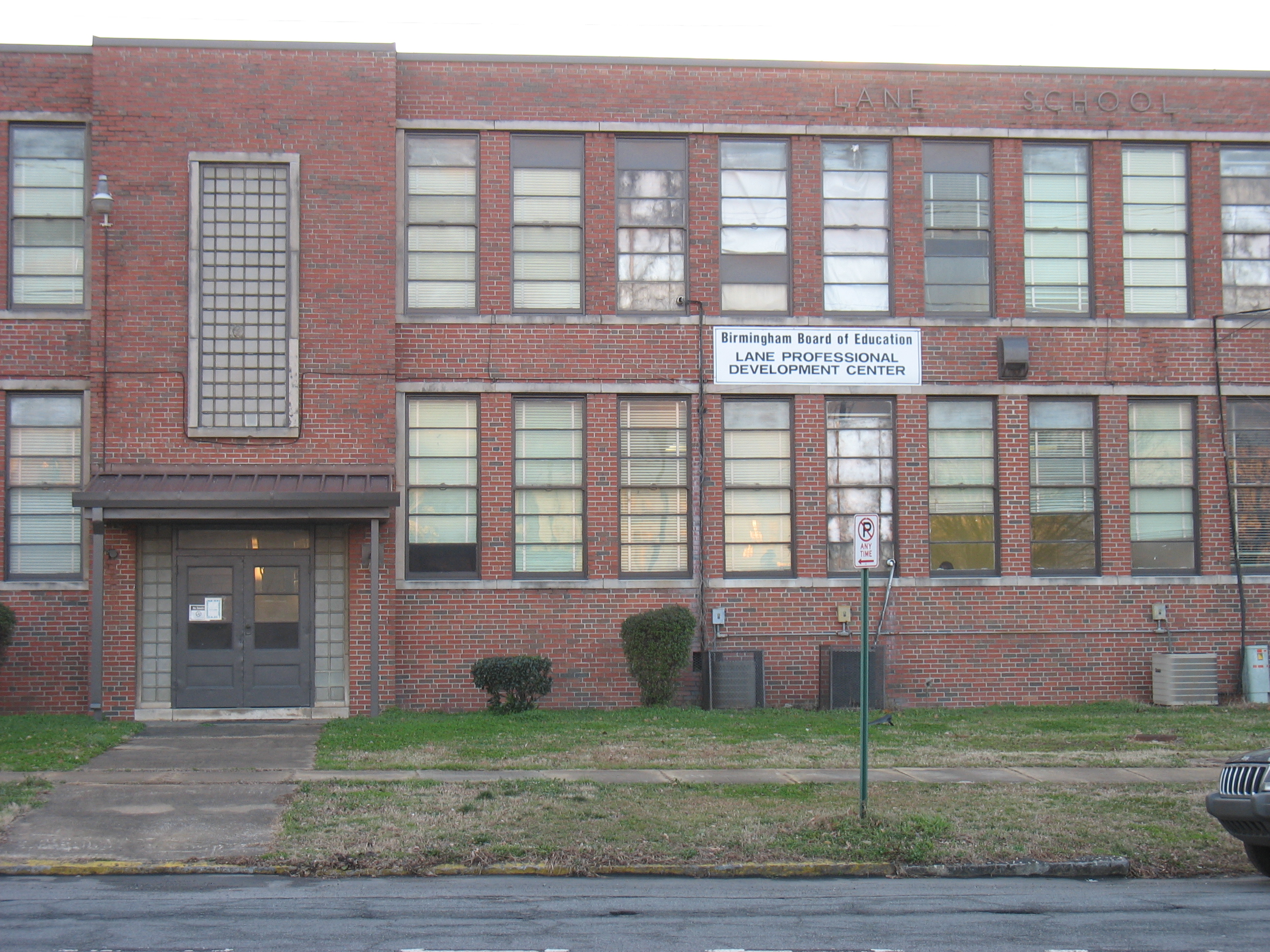
The Lane School--languishing in the shadow of UAB

The News has reported (and editorialized ) the story of UAB offering Birmingham City Schools $3.13 million for the old, former Lane School building at the university campus. The School Board president made a statement that, instead of selling the school, the Board should consider building a new headquarters building there instead (the City School website lists the Lane School as a “surplus property” for sale) .

Rather than discuss politics or the woes of the Birmingham City Schools, this is an opportunity to discuss possible solutions: 1. We have a shrinking urban school system with underused or unused buildings, and 2. the system’s (outdated) headquarters occupies a piece of very prime real estate facing Linn Park at the corner of 20th Street.

What would an enlightened city do?

Let’s start with the current site of the School headquarters on Park Place. This building, never a true architectural gem to begin with, suffers most from a mismatched location. Not only is it a dated, 3-story office building occupying that prime corner site, but the majority of its facade along 20th Street is the mainly blank wall of the parking garage. Hardly a generator of activity on the sidewalk.

There was a plan in 2004 to build a 14-story Westin hotel here, but the Board has rejected this and all subsequent offers to buy this property (in part due to the perceived expense of building a new headquarters). What if the Board agreed to sell the lot to a developer, and in return a dynamic, mixed-use building including space for a new headquarters was constructed? Or, alternatively, a brand-new charter or magnet school, that could signal the system’s determination to turn things around? Or a combination of all of the above?

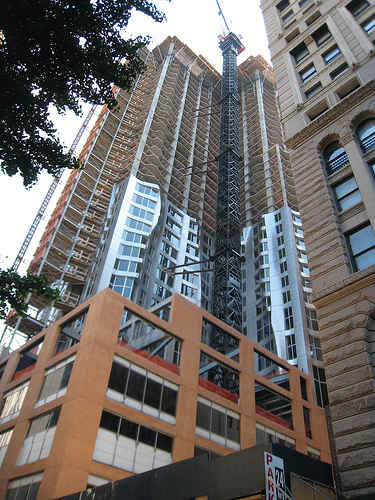
This idea has a parallel in Lower Manhattan right now. For years, neighborhood residents have been demanding a new school (K-8) but due to high land costs, it never materialized. In return for certain state and local incentives, a developer agreed to build the new school at the base of a 76-story luxury apartment tower (the Beekman, designed by Frank Gehry; under construction). In the picture here, you can see the brick school at the base of the tower:

Beekman School and Tower

(pic via jskrybe)

We are hardly in New York (but hey, like the new Beekman school, did you know the Advent Day School, a block from the Board HQ, has a rooftop playground?); but what if the current Board site was redeveloped into new board offices, an innovative charter school on the park, and private offices or condos/hotel above. And a great restaurant facing the park? What if?

But what about all the other outdated school structures, like the Lane School? These are dotted all over town–where changing demographics have forced school closures and realignments.  Old schools can make some really awesome living units.  When we looked at renovating the Phoenix Building some years ago, and thought about maintaining the best parts of a historic structure, we looked at various school rehabs across the country for inspiration.  Where else can you live in a basketball court? Check out the Union Square Condos in Grand Rapids, MI—a very innovative transformation of an obsolete neighborhood school.

Or closer to home, the old Crogman School in Atlanta was almost razed. Instead, it became reborn as the Crogman School Lofts, an affordable housing and community center that has helped revitalize a neighborhood.

Old Schools can be turned into community assets.  Market rate or affordable housing;  art classes and community meeting spaces.

And prime corner lots facing major city parks need innovative, mixed-use approaches to help spur further growth and foot traffic. Here’s hoping the School Board can strategize thoughtfully and carefully about how it could help it’s own bottom line, while helping the communities surrounding its properties.

Happy Hipsters (2)

There’s an interesting post up at FreeThinkBham: a Hipster’s Guide to Birmingham. As the post states up front, the term “hipster” is a tricky one, with some negative overtones.

But overall, the idea of making the city more attractive to young (and young-ish) creative and “alternative” types who don’t necessarily fit into the football, frat-boy, gated-community-in-the-suburbs mainstream is a good one.

Don’t get me wrong–we need football, frat-boys, and suburbs, if not necessarily gates. But we also need to be open and welcoming to diversity in all its forms, because the growth of any city depends on it’s openness to new ideas and different ways of thinking.

Richard Florida, anyone?

Photo courtesy Wes Frazer.

Mind the Gap (1)

How many crumbling historic (and gorgeous) buildings do we have to tear down, how many dilapidated Arts and Crafts style bungalows or shotgun houses have to be razed, or how many weedy lots do we have to witness before we do something? We have got to stop wasting the opportunities we have right in front of us before we sprawl our city all the way to Clanton

Why do we have so many gaps in our urban fabric…parking lots where buildings used to be, empty lots in our historic residential neighborhoods, historic houses abandoned or burned down?

There are many reasons, but the result is all about density — or lack of it. If you’re concerned about transit, or grocery stores, or dog parks, or walkable blocks, start thinking about density. Density provides the riders for bus routes or rail, the shoppers for the store, the canines for the park, or the consumers for restaurants, late-night coffee shops, and skate shops–which of course means pedestrian traffic and active storefronts which make a block walkable.

In a city like Birmingham, which used to be denser and more populated, we had, according to the 2000 US Census, 242, 820 residents and a density of 1619 people/square mile. Compare this to the 1950 census, when we had 326,037 residents and a density of 4,993 people/square mile. And our population is estimated to be a good deal less in 2010–closing in on 200,000 residents. [We are talking city limits of Birmingham here, not the metro area, which of course is considerably larger, much more populous, and also even less dense than the city proper].

Then take an older city like Providence, RI: in 1950 it had 248,674 residents and a density of more than twice Birmingham’s at 13,892 persons/square mile. By 2000 it’s population was down to 173,618 but it’s density was still considerable at almost six times Birmingham’s: 9,401/square mile.

Unlike some other cities which have deliberate density initiatives, we have been watching passively as people leave the city without enough new residents to replace them; new land is not annexed for dense development but for sprawling shopping centers; and of course gentrification occurs in certain older, desirable neighborhoods (such as Highland Park and Forest Park), where formerly subdivided residences are renovated back to single-family houses, new zoning laws prevent apartment buildings from easily being constructed, etc.
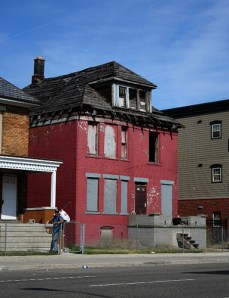
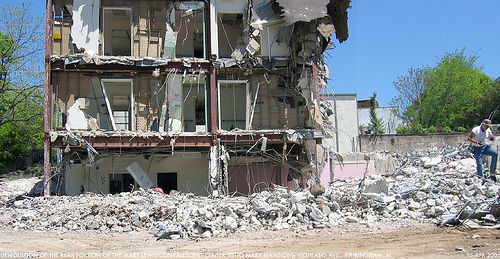
Abandonment in Detroit courtesy of desertchick.

The extreme end of this spiral is a situation like Detroit, where the mayor in late 2009 gave a startling admonition to his city: instead of pretending to still be the city of 2 million as designed, it should instead “focus on being the best 900,000 populated city that we can be.” (New York Times, Sept. 25, 2009).  His practical argument: the city is wasting tax dollars, man power, and energy by cleaning, policing, fire-preventing, and generally maintaining city streets where a large number of houses are mainly abandoned. People have a hard time imagining being forced from their own neighborhoods to live in denser cores, with the old, underused neighborhoods being turned into green space–but this, in effect, is what the mayor suggested.

OK. We aren’t quite there yet, but unless we institute policies to combat the trend, we may get there. Already we have a strained police force and fire force whose jobs are much more difficult due to the spotty inhabitation of certain neighborhoods. It’s all inefficient in so many ways.
Lacking any density initiatives locally (see Vancouver’s density charter as an example), developers have been creating their own density mainly as a perception of market demand. A few years ago we designed the Southside Townhouses as an urban infill project right off Highland Avenue.
Southside Townhouses–possibly the only 5-story rowhouses in Ala.!

They are in an eclectic neighborhood at an intersection surrounded by buildings of many styles and types–historic old apartment buildings, a large mid-rise modern apartment block, and some new and old houses. There are many neighborhood activists who objected to the multi-family project, as well as the appearance, so I would describe the project as locally controversial, but in the end I stand by its scale, its materials, the way it addresses a very multi-layered intersection, and of course its replacement of a vacant lot with some density.
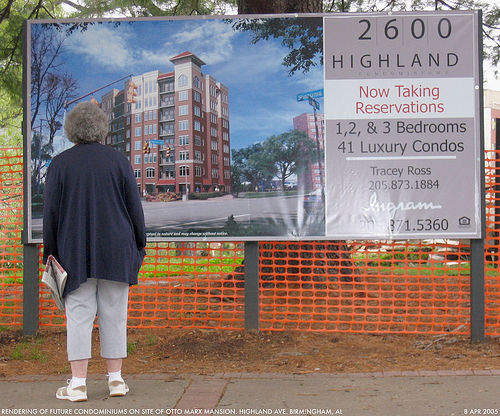
Another controversial project was later constructed just up the street, when the former Otto Marx mansion was torn down to make way for 2600 Highland, a condo tower. While bringing new residential density to its site, the loss of the historic house was painful to many. Thanks to dystopos for the shots below of the old mansion about to disappear, and a rather poignant shot of an older woman scrutinizing the marketing billboard for the new tower:
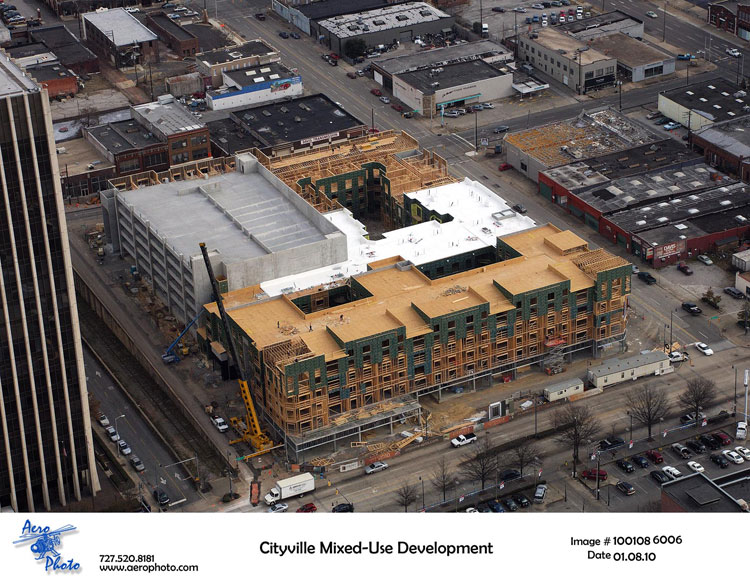
An example of new density that has thus far avoided the controversy of our own project and 2600 Highland is the CityVille Project put together byCorporate Realty: A half-block replacement of 1- and 2- story commercial and parking lots with a mid-rise, mixed-use development with apartments above and shops and restaurants below, with a parking deck buried in mid-project. Here’s a recent pic from the Cityville website showing the current state of construction:
We have big problems in this city with sprawl, and all the negative social, economic, and aesthetic issues that come with it. Re-densifying neighborhoods is one way to start solving these issues. And the denser a neighborhood, the more activity and amenities it supports, which in turn draws more people to enjoy these things, and we reverse the cycle that we’ve been in for decades here. And it can start with building a small, affordable, cool house on an empty lot in Norwood or College Hills. Or, bringing more housing to suburban centers such as downtown Homewood or Mountain Brook Village.
Coming soon…more infill inspirations from around town and around the country.

Happy Hipsters

“There. He felt it again. The whole house had unmistakeably slid toward the retaining wall, as if inching toward edificial suicide.”

I know this link has been bouncing around, but I thought this would bring a smile to those of us who appreciate modern design–it’s good to take a step back and have a sense of humor every once and a while.

I’m reminded of cracking open my first Wallpaper magazine back in 1998 or so: I was fascinated that there could be a consumer market for all things modern, hip, and glossy. It felt refreshing since, at that time, you’d be hard-pressed to find modern design in any “lifestyle” magazine, much less in mass-market catalogs.

Now, of course, from Dwell to CB2, it’s everywhere. Hence a little of the ennui pictured in today’s light-hearted link.

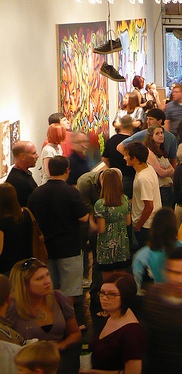
Not to get too sad about things–to the left is a pic of some relatively happy looking hipsters at the fabulous graffiti show at Bare Hands Gallery a few months ago. Then again, who couldn’t be happy at an art opening at Bare Hands? Thanks to Dystopos for the pic!

(via Unhappy Hipsters Photo: Jason Schmidt, Dwell, February 2010)

Railroad Park Development

As most of us concerned with Birmingham’s urban fabric know, the long-awaited Railroad Park should be open to the public in later this year. It is one of the few major elements of the downtown Master Plan that has come to fruition. Which is why we need a Redevelopment Authority–but that’s a subject for another post.

We, and several other architects, provided Operation New Birmingham with some concept sketches of a hypothetical development bordering the new park. The Birmingham News published the various drawings in an article today and has an online poll asking people to vote for their favorite.

Our sketch was very open-ended and more abstract than the others (and perhaps less accessible to the general public?). I wanted to take the artificial “nature” of the park and contrast it with the artificial “structure” of the architecture, a large concrete frame where solid and transparent surfaces move in and out of the frame.

If nothing else, it’s so rare in this city to have varied design proposals for anything, that I’m pleased to be part of this effort. It will be interesting to see what actually gets developed at the park. Baseball stadium, anyone?

Death of a Gypsy…

…and we don’t mean Carmen.

So, my local convenience store just closed a couple days ago–I ran across the street last night to get a couple tomatoes and found the “closed” sign on the door, and the interior was clearly in the process of being emptied.

Here’s a pic of the facade of the  Gypsy Market. Closed.

Now this brings up an interesting discussion–there was another “Neighborhood Market” around the corner that closed maybe 2 years ago. While the Gypsy seemed more in tune with the eclectic vibe of our urban ‘hood, neither its owner nor the owner of the Neighborhood Market struck me as being great business people, with solid plans for stability and growth. We need convenience stores downtown; we need local grocers; and we need supermarkets.

In Birmingham, for years we have heard the same argument. It goes like this: “Supermarket chains typically need approximately [insert high number here] people living within a 3-mile radius, and downtown is not ready yet. Not enough people.” More recently, there has been serious consideration of smaller, “urban footprint” type supermarkets that would be positioned geographically to serve both the north and south sides of central downtown–i.e. capturing the large UAB market to the southside.

What we’ve been missing is coordinated, professional efforts combined with incentives that other cities have used to induce supermarkets to come into areas traditionally avoided by chains that are oriented to the suburbs. Check out Greenlife Grocery in downtown Chattanooga which is like a mini-Whole Foods or Trader Joe’s.  And, unlike Birmingham, Chattanooga boasts a truly comprehensive, coordinated effort to induce a more mainstream supermarket into downtown: you can check out this executive summary from 2007 for a taste.

Cities cannot just wait for markets to come–they’ve got to get organized, aggressive, and in many cases offer incentives. Washington, DC has a specific incentive for inducing supermarkets to enter the city, which has had great success. I remember when the U Street neighborhood there was a relatively shabby area with no good supermarket. About 10 years ago the city passed their incentive law, and a developer put together a mixed-use project with Whole Foods as an anchor. The rest is history–the grocer helped spur retail and condo development across the neighborhood (although gentrification had started a few years earlier, Whole Foods accelerated it). Thanks to Maryland Route 5 for the pic:

Markets can be fantastic growth generators for neighborhoods. I think downtown can support both a full service supermarket, as well as at least a couple small convenience/local groceries, if they were done intelligently and backed by the right research and business plans. And, of course it would be nice if they could match the quirky vibe of downtown, as the Gypsy did manage to do.

And by the way, gentrification is a complex topic that will weave it’s way in and out of this blog. Suffice it to say that right now, downtown Birmingham has NO local grocers whatsoever, so we’re not talking about displacing local flavor with boring corporate chains. We’re talking about an essential service that’s needed. Now.

Architects Get Creative in a Grim Economy

I’ve stumbled on a couple stories recently–architects doing really creative things since there’s no architecture work out there. Something like 30% of architectural positions have simply disappeared in the last year–a devastating number. Most of the rest of us still standing are hanging on somehow, but I’m impressed/jealous/a little depressed by those designers who’ve taken completely new paths.

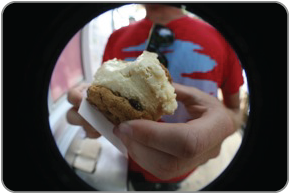
Some (former) architects who now sell ice-cream with architectural themes have a business cleverly called Coolhaus–a reference of course to Rem Koolhaas, one of my personal favorite super-star architects. I actually had him on a crit back at the GSD in the early ’90s when he was still unknown to most except a cultish following in design schools. Unfortunately this tasty looking ice cream is on the west coast, but in case you’re in Southern Cal sometime, you can track their whereabouts on twitter.

I’ve not heard of similar efforts here in Birmingham to combat the current crisis in architectural employment with some fun, original–and money-making ideas inspired by architecture but in a totally different business.

What if tomorrow a third of all lawyers were fired? Or teachers? Yet again I am reminded of the fact that architects are expendable in the US today, but oh how unattractive our world would be without us…now, would anyone stop on 2nd Avenue North in Birmingham for architectural advice if we were giving it at 5 cents like in Seattle?

Image courtesy of Coolhaus website!

Welcome to constructbirmingham!

Hello fellow bloggers, interested citizens of Alabama, and the world. I’m an architect and developer based in Birmingham, Alabama–my hometown. This blog is something I’ve mulled over for a while. It will center around the built environment of Birmingham–the good, the bad, the ugly–and will suggest, and hopefully stimulate, some ideas for constructing a better city. Here in Birmingham we have access to lots of resources about architecture, sustainability, walk-ability, and a few really good coffee shops–but no real local forum for discussing how our urban environment is made, perceived, dreamed about, sullied, improved, compromised—-constructed.

I plan to launch a series of topics that I hope will be interesting not just to those living in Birmingham, but to anyone challenged to make their own local environment more livable, more beautiful, more sustainable, more coherent, and more special.

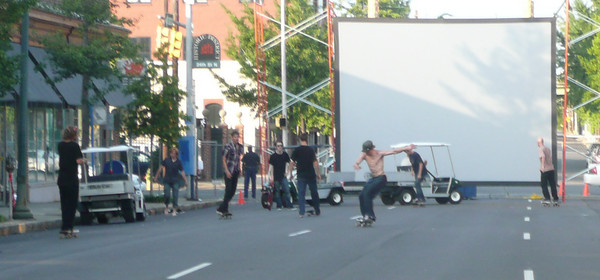
First real post to come shortly. For now, I’m leaving you with a little picture of some impromptu skating street life outside my office downtown.