Design review June 27

Here is this Wednesday’s agenda for the June  27 Design Review Committee meeting. Remember, the meetings are open to the public and take place at 7:30 AM at Auburn Urban Studio, 3rd Floor of Young and Vann Building, corner of 18th Street North and First Avenue downtown.

I.       Call to Order:  Minutes of the June 13, 2012 meeting.

II.        Name: Mr. Cliff Atkins

Site Address: Avondale Bricks

District:  41st Street

Requesting approval for: Signage

III.       Name: Mr. Ralph Sitz (Barber Companies)

Site Address: 500 28th Street South

District: Lakeview

Requesting approval for:  Paint

IV.       Name:  Mr. Ralph Sitz (Barber Companies)

Site Address:  608 23rd Street South

District:  Midtown

Requesting approval for:  Paint

V.        Name: Mr. Scott Phillips

Site Address:  201 41st Street (Avondale Brewery)

District:  41st Street

Requesting approval for: Egress Stairs; sign

VI.       Name:  Ms. Tonya Allen and Mr. Marcus Taylor

Site Address: 420 Richard Arrington Blvd., South (Merienda Lounge)

District: Midtown

Requesting approval for:  Outdoor Cafe

VII.     Name: Mr. Scott Phillips

Site Address:  215 41st Street (Saw’s BBQ)

District:  41st Street

Requesting approval for: Signage

VIII.   Name: Mr. Lance Black (Black Design Architecture)

Site Address: 4006 5th Avenue South (Parkside)

District: 41st Street

Requesting approval for:  Commercial kitchen installation

IX.       Name: Mr. David Wininger (Wininger Law Firm)

Site Address: 517 21st Street

District: 21st Street

Requesting approval for: Mural

X.        Name:   Mr. David Rawson (Gonzalez- Strength & Associates)

Site Address:  2006 Avenue I, Ensley (Dollar General)

District:  Ensley

Requesting approval for: New Construction

[thanks to City of Birmingham for the agenda]
Downward pressure

Historic neighborhood meets outdated zoning

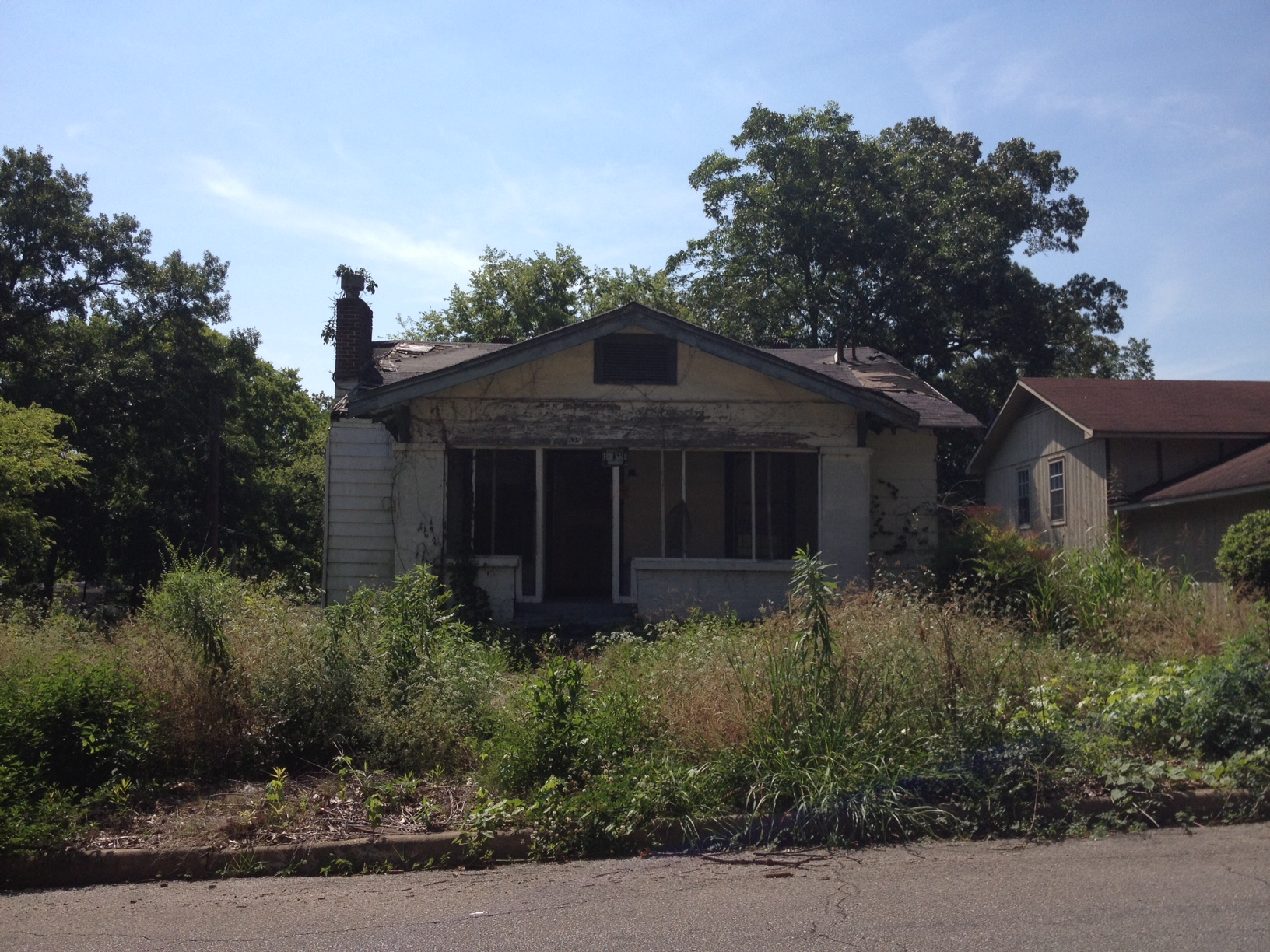
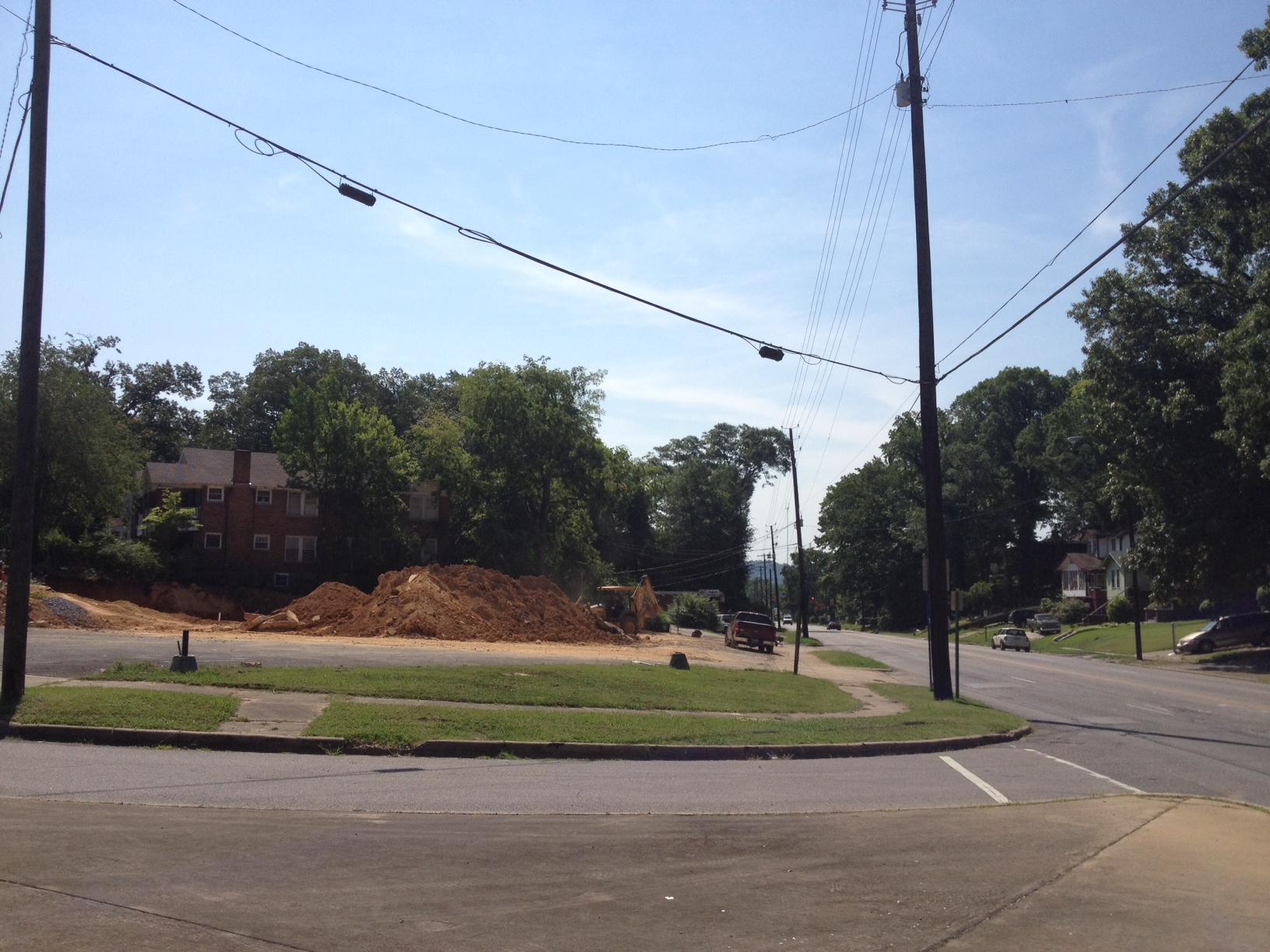
At yesterday’s City Council meeting a group of citizens from the historic neighborhood of Bush Hills in the west side of Birmingham gathered to protest the construction of a new service station and convenience store underway on a prominent corner in this mainly residential area (Graymont Avenue and 8th Avenue West, above). You can watch a video of the Council meeting here.

After one resident after another took the stand, councilors then replied that unfortunately this was out of the Council’s purview, as the site in question has been zoned B-1 for years, and this zoning allows a service station with no variance necessary. Thus, the developer of this property would encounter no neighborhood committees, boards of adjustment, etc.: she merely needs to submit plans to the planning department for approval, and they’re ready to go.

Not the new neighbor they were hoping for

Once again we have a situation where residents of an historic neighborhood (above, houses directly across Graymont Avenue from the site) object to the technically legal use of a prominent corner lot–the Five Points South Chick-Fil-A and Clairmont Avenue Walgreens projects come to mind. In each case grassroots efforts led by citizens helped convince the developers to redesign their projects using urban principles more in keeping with their contexts. Once again, the lack of neighborhood form-based code is making this a lot more complicated than it should be.

If we overlaid form-based code onto our existing zoning code, we could single out certain prominent intersections, or corners, to insist that any development’s form would need to be urban-friendly (i.e. buildings built out to sidewalks, certain percentage of storefront glass/entrances directly facing streets, parking areas hidden at the rear, etc.). It wouldn’t prohibit service stations, but it would require either an extremely creative design–or otherwise influence the developer to look for another less restrictive lot (located outside an historic residential neighborhood, and therefore more appropriate for a service station).

Part of the challenge

So far the City’s Highland Park neighborhood and Jefferson County (which covers unincorporated, and thus typically less dense, areas) have adopted form-based codes. Highland Park–with its wealthier, well-educated residential base–organized, paid for, and lobbied for the new code. As the above Bush Hills residence around the corner from the site demonstrates, this neighborhood has vastly fewer resources. The fear of the citizens yesterday was in part economic: already facing a downward spiral pressure on home values and multiplying vacancies, the introduction of a gas station could make the surroundings less desirable, augmenting that spiral. We’d love to see a solution to this continual problem, because the more we mismatch uses within our historic neighborhoods, the harder it is to convince residents to remain.

Happening, maybe

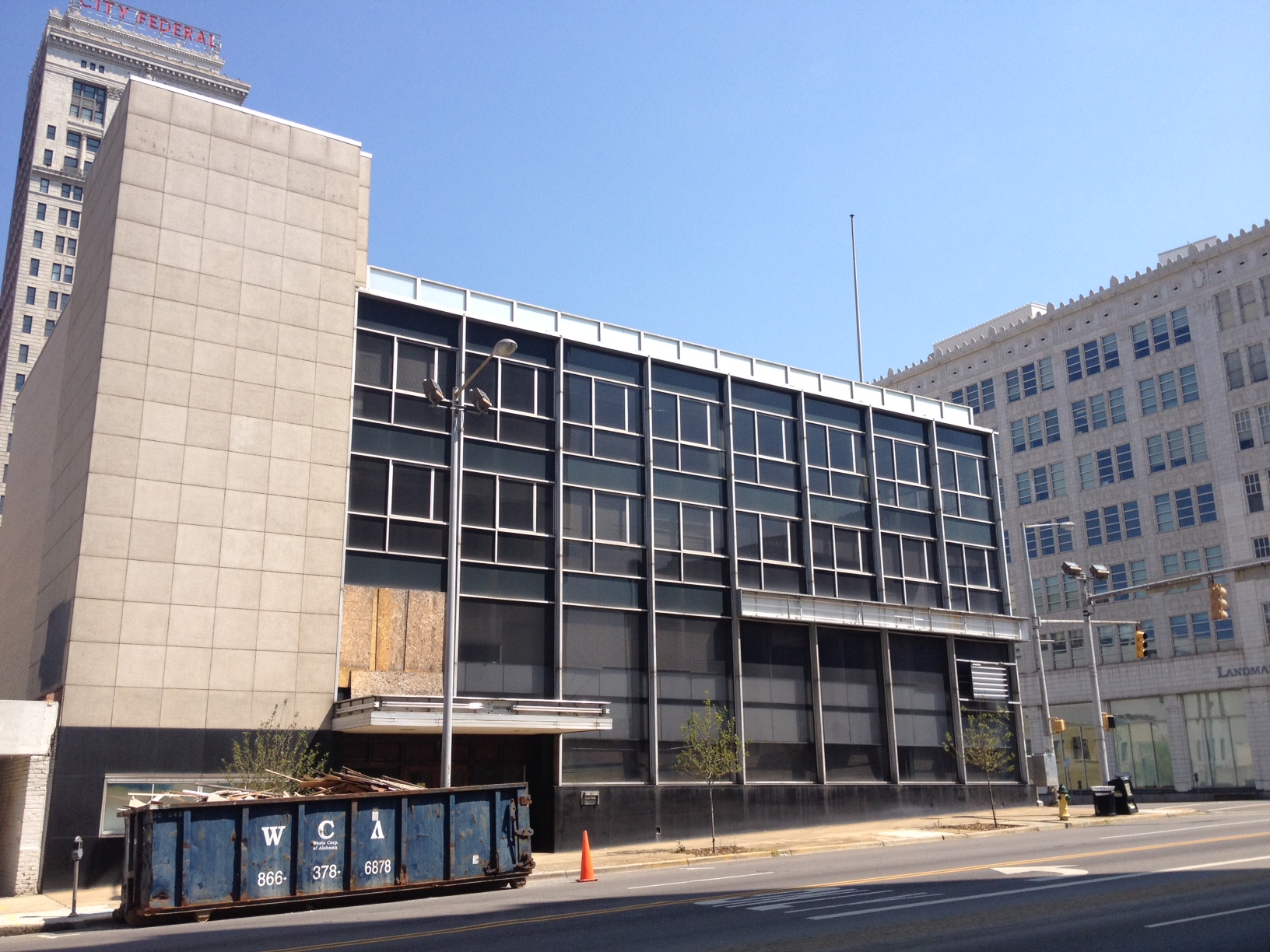
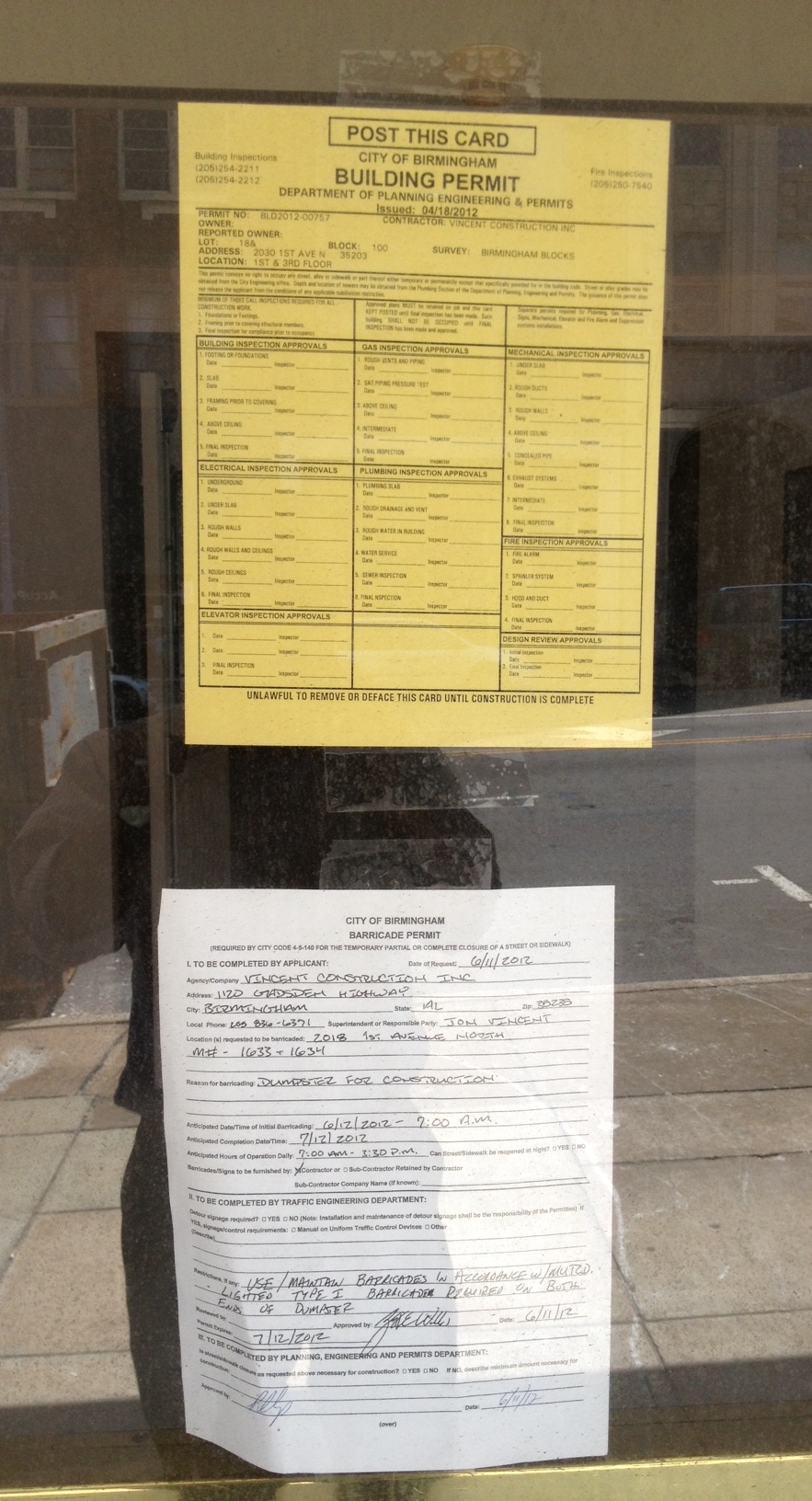
On another note, a reader pointed out that permits for demolition and a dumpster have arrived at the former First Federal Savings and Loan building on the corner of First Avenue North and Richard Arrington (above). We reported a year ago on the Design Review Committee giving conceptual approval to a mixed-use redevelopment in this modernist structure. Perhaps this is the beginning of that project, or it may be something else; it’s hard to tell.

Hard to figure

It’s illustrative to look at the publicly posted permits above; they tell us about demo permits and dumpsters, but not about what’s actually happening to the building.

A better way

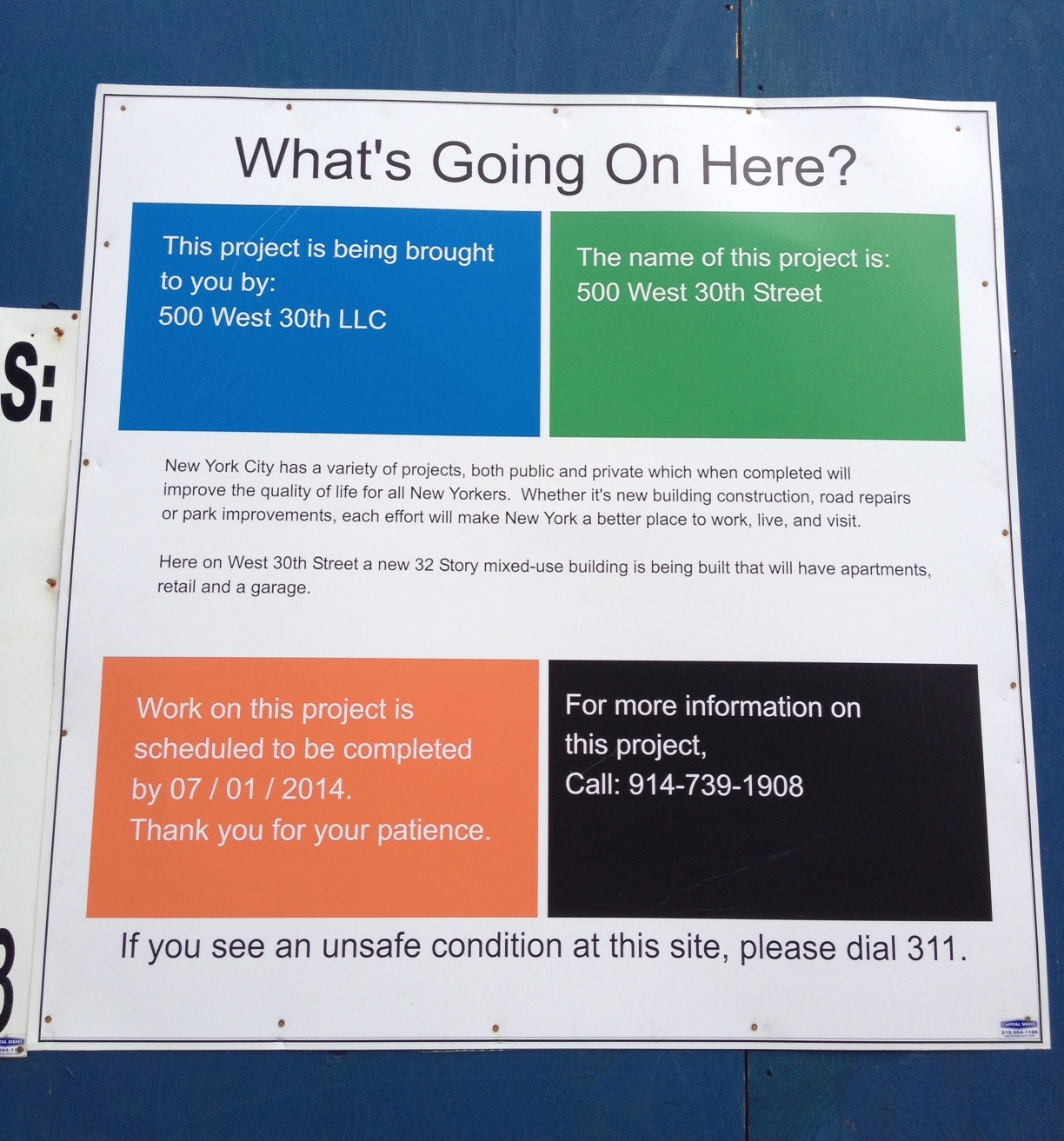
Other cities treat construction projects not just as private developments (which they often are), but as contributors to the greater urban fabric. Above is what’s found on any building site in New York City, informing the public about the nature of the project, who the developer is, and who to call for more info. Yes, this takes resources to organize and implement. But it’s a worthy goal for any city to strive for. It educates the public; piques the interest of other developers; and increases the public trust. For the time being, we hope the dumpster is a sign of fresh life for this downtown corner.

Urban retail

More of these, please

The growth of retail establishments downtown has not kept pace with the growth of neighborhood population. Why? In part because populations must reach tipping points before retailers will consider new locations, and for certain businesses our population is just not there yet.

However, another reason is that downtown doesn’t have the right available space in the right locations. Take the growing Second Avenue district and the retailer Charm (above), in the 2300 block of Second Avenue between 23rd and 24th Streets. There are bars, a coffee shop, a corner bodega, and a skate shop on the block–all very complementary to Charm’s vibe. What we now need are a couple more retailers to step up and join the district–and indeed several have been searching for small space at reasonable rents. But it’s proven very hard to find.

Not the best and highest use of this corner

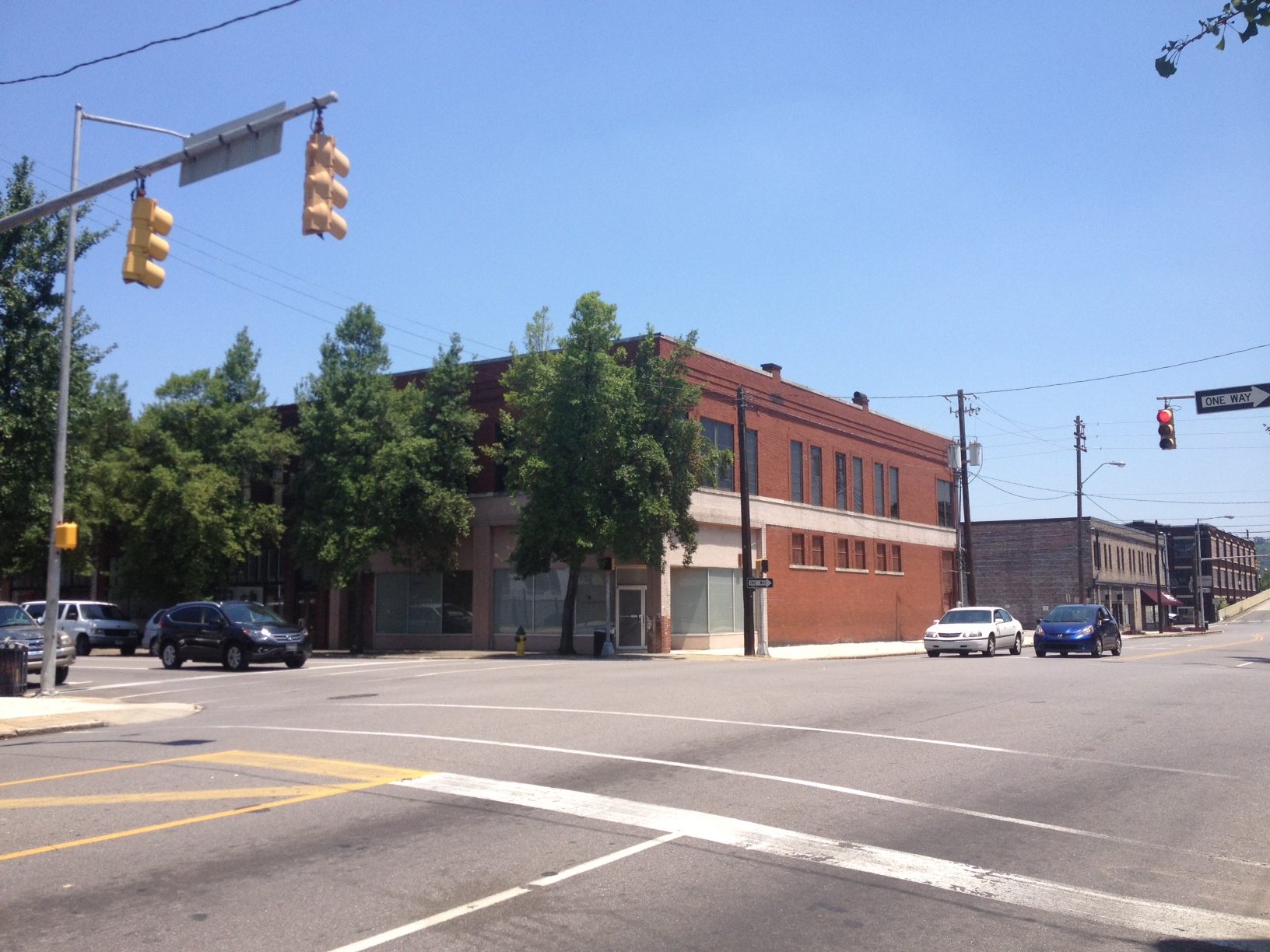
While there is plenty of vacant retail storefront downtown, much of it is too big. If it were subdivided into smaller, reasonably priced spaces it would be easier to fill. Unfortunately many building owners don’t want to go to the expense of speculative renovation for a market that’s still seen as pioneering. Above is the building at the SE corner of 24th and Second Avenue North, right down the street from Charm. Most recently professional offices, it was bought last year and is seemingly vacant: it’s storefront blinds are drawn, and no renovation work evident. It’s a big blank non-contributing element to the district right now.

Better and higher use

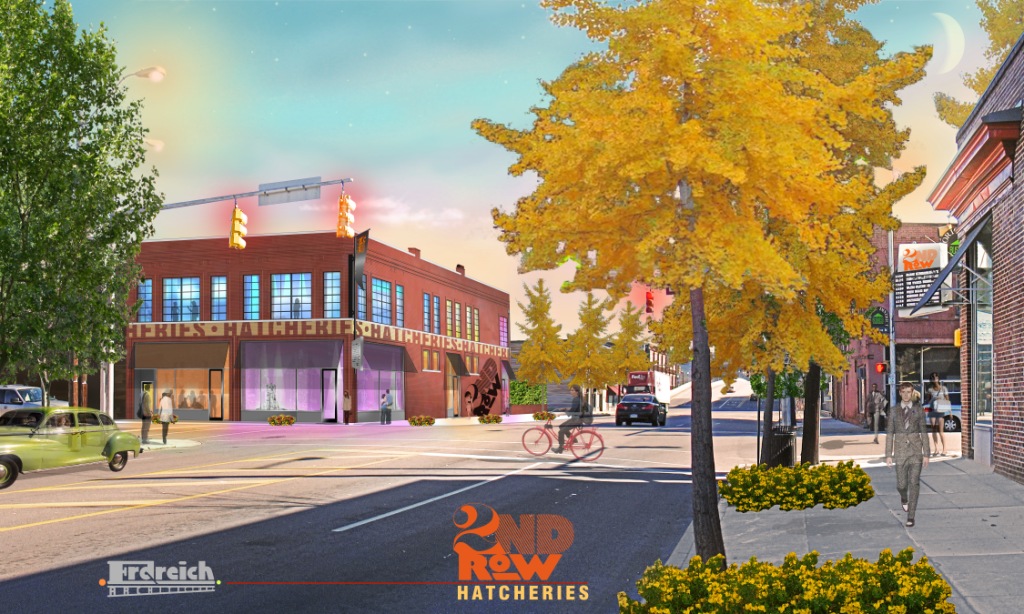
Last year we worked on a concept project with the previous owner (above) that would have created smaller retail storefront spaces on the first floor, and updated the building with a clean, graphic aesthetic complementing our 2nd Row project of 2007. If this city had a Redevelopment Authority, perhaps it could’ve identified this property as key to the growth of the Second Avenue district, bought or leased the space, performed the necessary renovations, and then marketed it to retail and restaurants. We have nothing like that here, which inhibits our getting traction or critical mass again and again (although Main Street Birmingham has had some success with similar ventures in the commercial centers of Woodlawn and Avondale).

Getting proactive

Once again, the smaller city of Mobile to our south is ahead of the curve: the Downtown Mobile Alliance (equivalent to our Operation New Birmingham) has acquired a spacious former retail space on Dauphin Street downtown (above) and created the Urban Emporium. Here, start-up retailers can rent small spaces with shared overhead, checkout, etc.–a retail incubator, if you will. It allows retailers interested in downtown to introduce themselves to the neighborhood at minimal expense. The idea is they grow a customer base, and then graduate to their own space elsewhere downtown. Birmingham needs to do something similar. Otherwise, we’ll keep losing opportunities like our aborted project above, while eager but frustrated entrepreneurs keep searching. Their search may lead  to other neighborhoods altogether if we don’t have a plan in place to accommodate them.

Critical mass is typically a combination of the organic and the planned. Here on Second Avenue North the organic has come a good ways. It’s time for some planning to keep it going. More on that next post.

[thanks to Downtown Mobile Alliance for the Urban Emporium pic]

Parking, meters, technology (2)

The 21st century gives way to the 20th

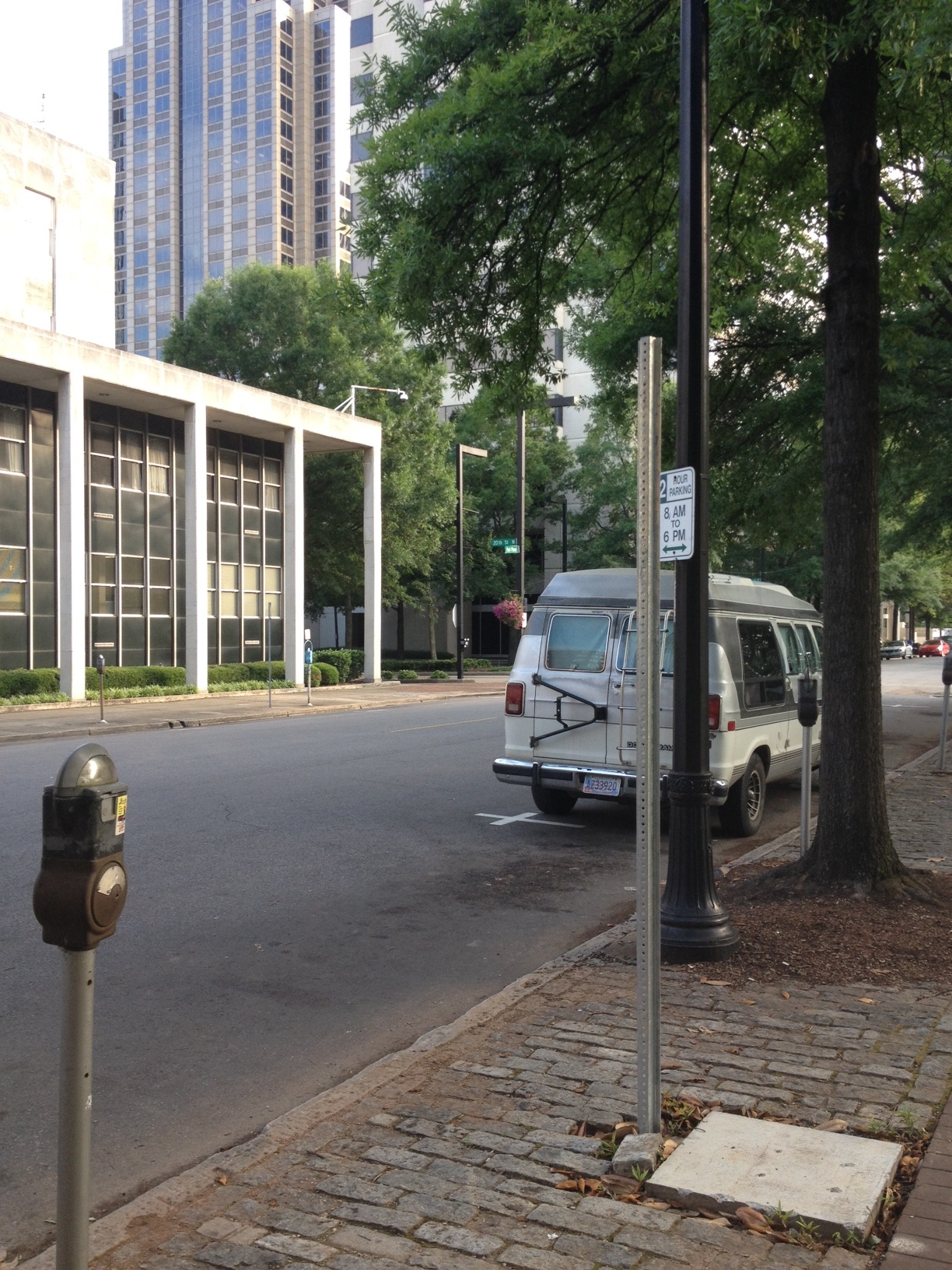
Late last year we discussed parking technologies and the pilot program of smart metering that was implemented around Linn Park downtown. Those high-tech meters–solar powered, accepting credit cards, remotely programmable for different times of day and week, etc.–are now gone. Instead, above we see standard old-fashioned meters once again lining Park Place, and a blank sign post which used to say “pay here” standing next to the empty concrete pad which held the machine.

Does anyone know if the pilot program was deemed successful, and whether this is a temporary regression before rolling out new technology across the city? Or is this an indication of something else? While this is just one piece of upgrading our urban parking system, it’s a vital one.

Design review made easy

You asked for it, you got it: the agenda for next week’s June  13 Design Review Committee meeting. We will now do our best to post this in raw form for our readers whenever we receive it. Remember, the meetings are open to the public and take place at 7:30 AM at Auburn Urban Studio, 3rd Floor of Young and Vann Building, corner of 18th Street North and First Avenue downtown. Enjoy!

I.        Call to Order:  Minutes of the May 23, 2012 meeting.

II.        Name: Mr. Steve Reeves (SDR Studio)

Site Address: 1313 6th Avenue, North, Alabama Power

District:  Downtown Northwest

Requesting approval for: Storm shelters

III.       Name:  Mr. Steve Reeves (SDR Studio)

Site Address: 900 18th Street, North,Alabama Power

District: Cultural

Requesting approval for:  Storm shelters

IV.       Name: Mr. Lance Black (Black Design Architecture)

Site Address: 4006 5th Avenue South (Parkside)

District: 41st Street

Requesting approval for:  Commercial kitchen installation

 V.        Name:  Mr. Dan Aycock (Blair Remodeling)

Site Address:  718 39th Street South

District: AvondalePark Local Historic

Requesting approval for:  Vinyl/composite siding, vinyl soffits, new cornice, window installation, and painting

 VI.       Name: Ms. Kim Busby / Mr. Hal Word

Site Address:  2008 3rd Avenue, North (WattsBuilding)

District:  Birmingham Green

Requesting approval for: Storefront Repairs

VII.     Name:  Mr. Mike Gibson (Appleseed Workshop, LLC)

Site Address: 2033 Morris Avenue (Victoria Station)

District:Morris Avenue

Requesting approval for:  Office Renovation

VIII.    Name: Mr. David Brandt (Fravert Services) 

Site Address: Children’s Hospital Campus – 1600, 7th Avenue S (McWane), 6015th, Avenue, S (5th Ave. Deck), 1501 7th Avenue, S (7th Ave. Deck), 1600 5thAvenue S (Park Place South)

District:  Midtown

Requesting approval for:  Signage

 IX.       Name:  Ms. Lara Watson (Reliable Signs Services)

Site Address: 120 18th Street, South,Railroad Square

District: Midtown

Requesting approval for: Signage

[thanks to City of Birmingham for the agenda]
Diversity = urban growth

Five Points embraces us all

Look around the country, and the most dynamic cities tend to be truly welcoming: these cities encourage out-of-towners to relocate and join local civic pursuits, and they robustly embrace all minorities and cultural groups while harnessing their diverse energies towards a greater good. During Pride Week, we’re reminded that Birmingham is a relative bastion of urban tolerance–if not always acceptance–within a state that’s often feels otherwise (rainbow flags fly at the center of Five Points South, above).

Not your everyday backdrop

It was particularly heartening to attend a Birmingham Business Alliance board meeting the other week (above) that was held not in the usual corporate auditorium, but at the Birmingham Civil Rights Institute gallery housing the Living in Limbo exhibit. This groundbreaking exhibit about lesbian families (which runs through this weekend) was a fitting backdrop for local business leaders to discuss the future of this region. We all need to be reminded that this city (and its region) is truly a rainbow–and all of us should work together to celebrate that diversity and base a better urban place upon it. Happy Pride, Birmingham.

Checking in (3)

Your Polish great aunt may be disoriented

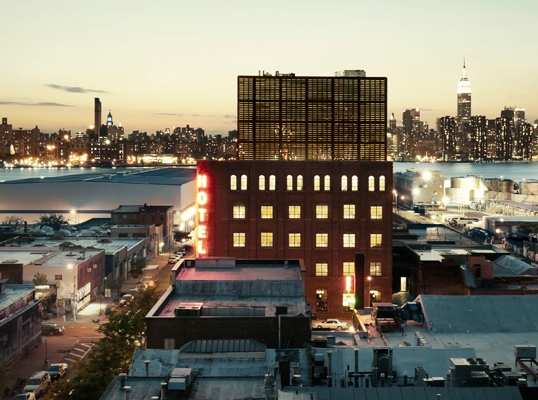
We’ve discussed good urban hotels (or the lack thereof) in a couple of previous posts (here and here). As innovative boutique hotels have gone up in cities large and small, somehow Birmingham still lacks a truly memorable urban hotel that captures the city’s spirit. Yes, the Tutwiler Hotel has its charm, but the Hampton Inn vibe holds it back. We look forward to the new 4-star Westin–although its location at the BJCC and the new entertainment district makes it feel less integrated with the historic core (as can be the case with convention-oriented hotels). We dream of a Birmingham version of the new Wythe Hotel, shown above, rehabbed in an old factory in the Williamsburg neighborhood of Brooklyn that meshes the rough-hewn, immigrant aesthetic of that historic place with the uber-hip(ster)  reality of its modern-day environs. Think custom beds made from the building’s reclaimed pine beams and in-room surround-sound controlled by your iPhone.

Just use your imagination

Recently it was reported in the Birmingham News that the developer of the new downtown Westin, National Ventures Group, has been analyzing the former Regions Plaza building–currently vacant after Regions‘ merger with AmSouth–as a mixed-use development including a 4-star Wyndham Grand hotel at the lower portion (above, looking west along 5th Avenue North towards 20th Street). A 2007  plan for this site called for redevelopment into a Marriott Renaissance hotel, but this plan fell victim to the recession. National Ventures is quoted as stating the hotel would be unique to the state of Alabama, and inspired by–of all places–the Grand Hotel Europe in St. Petersburg, Russia.

That’s a lot of old-world imperial glory to inspire us

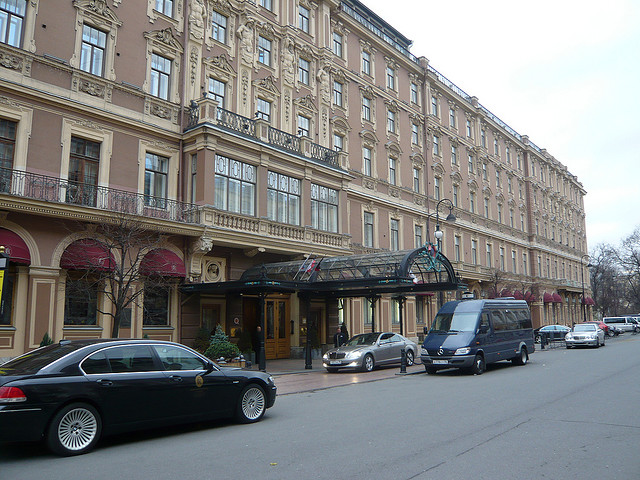
The Russian reference is odd because of the severe difference in architecture between the two buildings. The Regions Plaza–formerly First Alabama Bank Building–is an early-1970’s bronze and dark-tinted-glass period-piece of limited elegance and panache. The 5-star hotel in the former capital of the Russian Empire (above) is all neoclassical opulence, inside and out–from the fine stone carvings and cornices, to the crystal chandeliers, to the Art Nouveau woodwork of 1910 (the structure dates from 1875).

The way we were

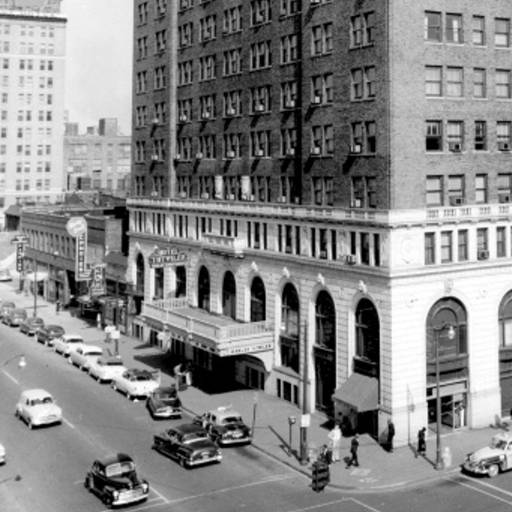
Ironically, the Russian inspiration might make more sense if we still had the original building on the site–the Tutwiler Hotel (above, looking east along 5th Avenue North, ca. 1956). Constructed in 1914 and demolished in 1972 to make way for the current structure, its grandeur and luxury were–at least for a time–renowned throughout the South. Stylistically it certainly shared more with the Europe than its replacement does. It will be interesting to see how this project develops.

A less glamorous precedent

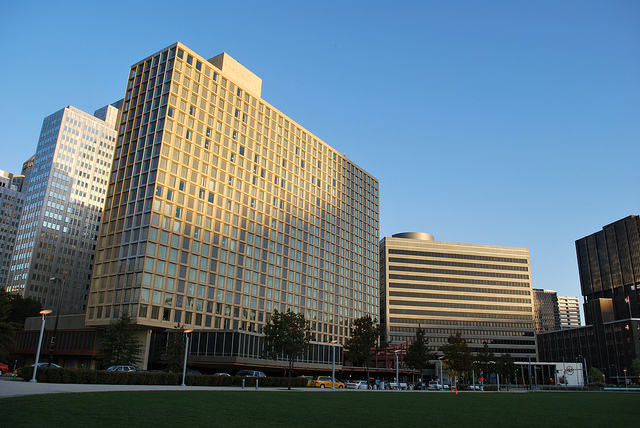
A quick search of Wyndham Grand hotels turns up the above, in downtown Pittsburgh. Now that’s a long way from St. Petersburg, but perhaps a more realistic precedent for understanding the possible look of the proposed hotel here. Because while the renovation cost of $30 million estimated by National Ventures isn’t insignificant, you can be pretty sure that doesn’t include recladding the building in plaster, limestone, and carved cornices.

Will the Wyndham answer our desire for a great, memorable urban hotel? Probably not. Could it fill a need for 4-star service in the heart of the CBD, activating the street fronts with bars and restaurants? Hopefully. If it–and the Westin–prove successful, could it help give confidence to that innovative developer to create that special boutique hotel of our dreams? Just possibly.

[thanks to Wythe Hotel for the exterior view;  deldal for Grand Hotel Europe; Birmingham Public Library for the Tutwiler; marcanadian for the Wyndham Grand Pittsburgh]

Caution: sterility

Pop-up district

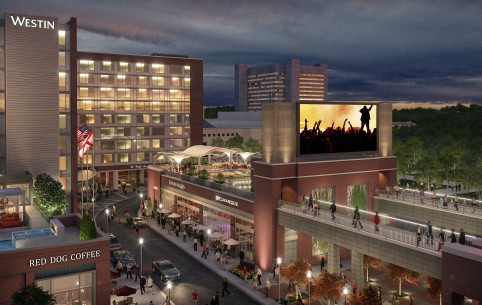
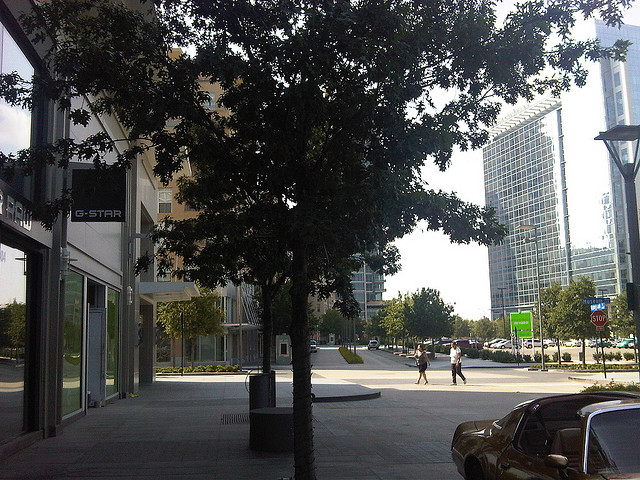
By now most of us are familiar with the planned Entertainment District currently rising east of the Birmingham-Jefferson Convention Complex; a night-time view is rendered above (see construction cam here). This blog has discussed the inherent risks with creating “districts” from scratch, and with single developers or entities calling the shots, as opposed to more organic neighborhoods that grow over time with multiple participants. A very interesting article in Salon takes a dim view of this type of development, and is worth a read and discussion of its points.

It fills up for New Years

The author, Will Doig, takes Victory Park in downtown Dallas, TX to task. For him this is an extreme example of how banal an instant district can be (the main plaza is pictured above).  A much bigger project than Birmingham’s (think billions instead of millions of dollars), it includes luxury apartment and condo towers, office space, a park, restaurants, retail, a W Hotel and the American Airlines Center (home to professional basketball and hockey, as well as a concert venue). It has all been built over the last 10 years.

But it’s not New Years yet

While the main plaza and other public areas fill up during game time, New Years, and other special events–the neighborhood is otherwise quiet, according to Doig: its overpriced chain restaurants drawing too few patrons, and a revolving door of retailers leaving sidewalks empty (above). Keep in mind that there is still much more development planned for Victory Park, so perhaps it’s too soon to judge. But it’s hard not to take seriously the criticism leveled by Doig about the lack of vitality in this type place.

Everyone’s inside looking at the art

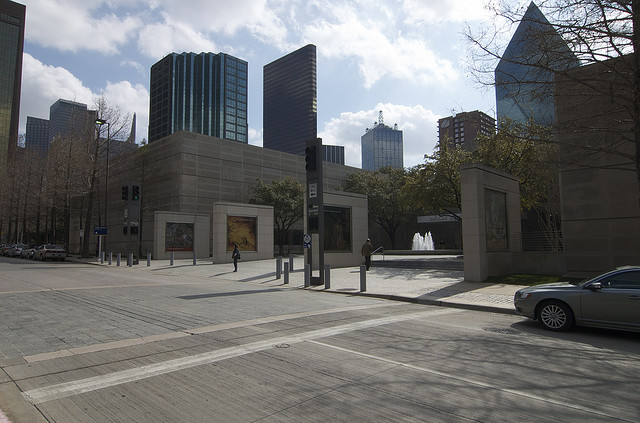
Doig also describes the Dallas Arts District as a related, but distinct example of the pitfalls of “designated district” development. A massive 68 acres of prestigious fine and performing arts venues developed over the last 30 years, it includes many well-reviewed architectural works (including the Dallas Art Museum above by Edward Larrabee Barnes, the same architect who designed the last expansion of the Birmingham Museum of Art). While there is much to admire about the high quality streetscape materials and refined architecture, street life itself is muted: unless you’re walking from an art museum to a concert, there’s just not much to do. It’s a mono-cultural district that suffers from too much of a good thing.

Ah, organic growth

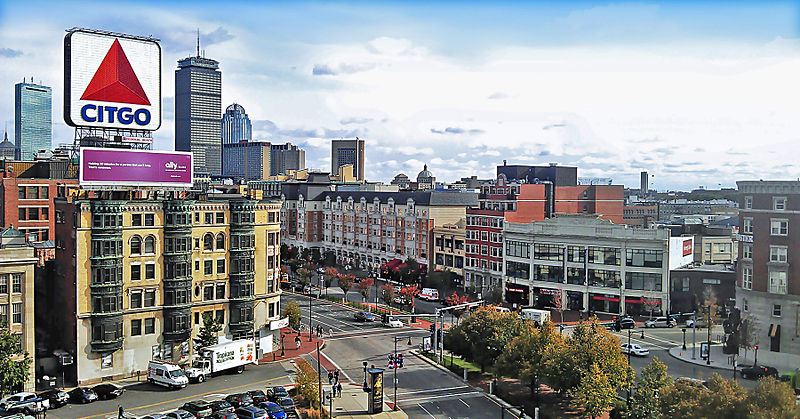
The counterpoint to these listless new districts for Doig is Kenmore Square in Boston, MA (above), whose slow growth over time has resulted in an eclectic, mixed-use neighborhood that feels perfectly suited to Fenway Park without being contrived. The famous Citgo sign is a microcosm of the argument: first erected in 1940, it became so beloved by neighbors and Red Sox fans that when it was dismantled as a tired eyesore in 1979, a huge public outcry led to its restoration. It’s just one more quirky layer of the neighborhood. Such a sign today would neither be allowed under city ordinances, nor particularly loved by the public: it would be too new, too crass.

Which brings us to a final point–when Kenmore Square was first built out and connected to Boston with a subway line 100 years ago, it probably had little of today’s charm. Our best neighborhoods often need time to grow, breathe, rejuvenate, go through cycles before we realize we love them. If the entertainment district is expanded, ties together successfully with our own art museum and CBD to the south, Norwood to the north, is connected to great transit, and finds the right retail mix–it may prove Doig wrong. Since we’re investing so much money and effort into the project, let’s hope so.

[thanks to Bayer Properties for the Entertainment District pic; ecrosstexas and payton chung for the Victory Park pics; tilton lane for the Dallas Arts District pic; henry han for the Kenmore Square pic]

Better signage, and a house

A model for the future?

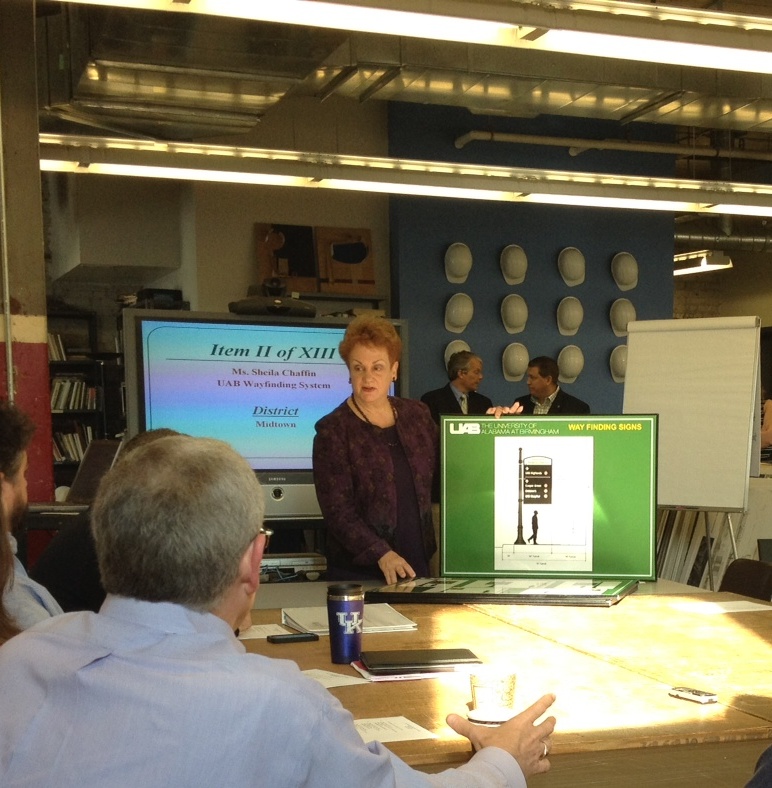
This morning at Design Review Committee the wayfinding proposal presented by Sheila Chaffin of UAB (above) was unanimously approved. Dozens of signs will direct people and traffic through the Medical District in a system coordinated between UAB, Children’s Hospital, VA Hospital, and Cooper Green Mercy Hospital. Complementing these will be UAB campus-specific signage–same style, but with the UAB logo on top rather than “Medical District.” MB3 Designworks of Virginia designed the signage, and local firm KPS Group coordinated placement and messaging.

We’ve commented several times on the urgent need for wayfinding in downtown Birmingham; hopefully this project will inspire the City to move that up their priority list. Because when we leave a well-marked Medical District, we still need to find our way around the rest of town.

Full renovation coming later

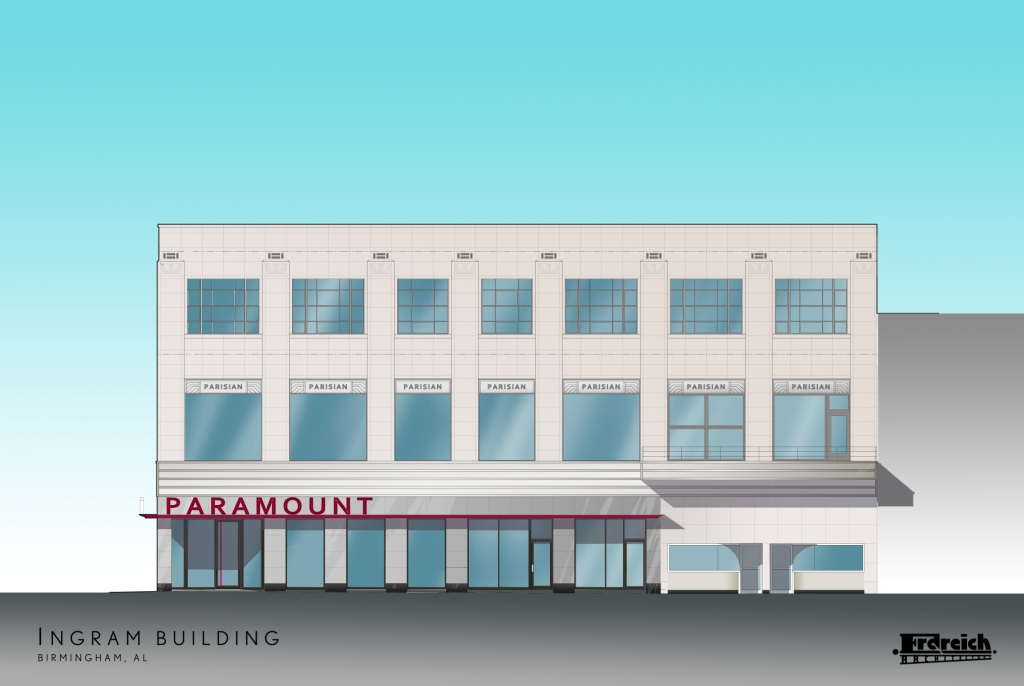
Approval was also granted for a neon-illuminated blade sign to be sited on the corner of 20th Street North and 2nd Avenue at the second-story level of the historic Roden Building. This sign, which is 8 feet tall and reads “PARAMOUNT” in a vertical format, is a temporary measure to advertise the Paramount store that opened last year and sells yogurt, sweets, and other items. Our office designed a complete exterior renovation (pictured above) for a future phase,  including larger illuminated signage running horizontally that was previously approved by the Committee. In the meantime, it’s exciting to see this great old building coming back to life step by step.

Man with a plan

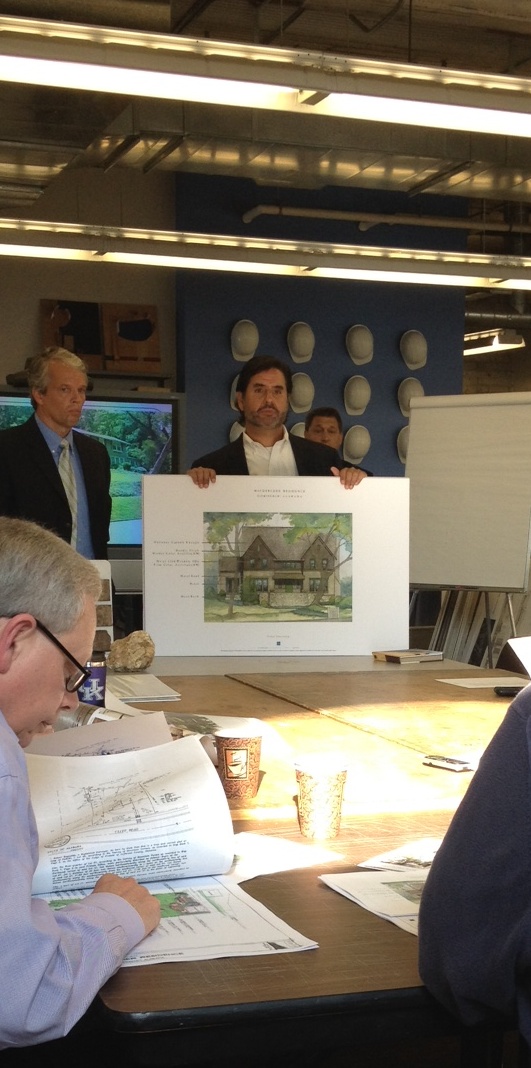
Finally, approval was also granted for construction of a new residence on Cliff Road in historic Forest Park (above architect Alex Krumdieck presents the rendering). It’s good to see continued investment in the historic residential neighborhoods surrounding downtown; a healthy downtown complements the neighborhoods, and healthy neighborhoods complement downtown. We need to support intelligent improvements in both to help build a city greater than the sum of its parts.

Happy Memorial Day everybody!

Safety and the Public Realm

It could be prevented

Two common elements that contribute to safety on urban streets: on-street parking, and 2-way traffic. Both serve as natural calming elements by increasing driver’s alertness and decreasing traffic speeds.

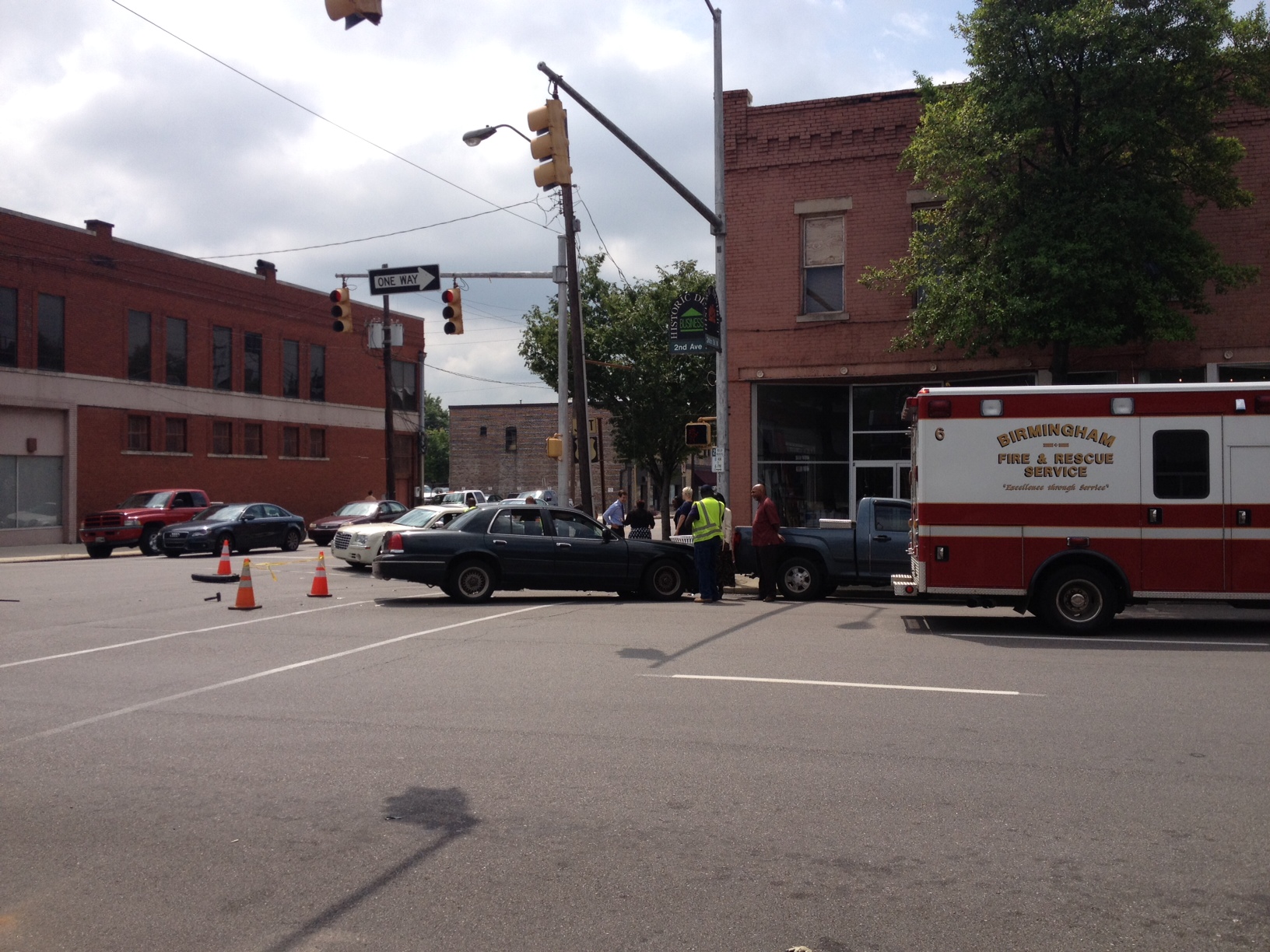
Unfortunately many of our city streets are still relics of traffic engineering theories from 50 years ago, when certain streets became one-way, while others had on-street parking removed to create more traffic lanes. An example is the intersection directly outside our office–24th Street North and 2nd Avenue (this morning, above), where almost monthly there is an accident involving some combination of cars racing too quickly down 2nd (one-way) and running lights on 24th (no parallel spaces). Both streets were altered long ago by traffic engineers as corridors for moving auto traffic across downtown–with no regard for pedestrian life, merchant visibility, quality of place, etc.

How many more accidents and injuries must we witness before we change the configuration of these outdated street designs?