Tag Archives: Five Points South

More signs of progress

Committed

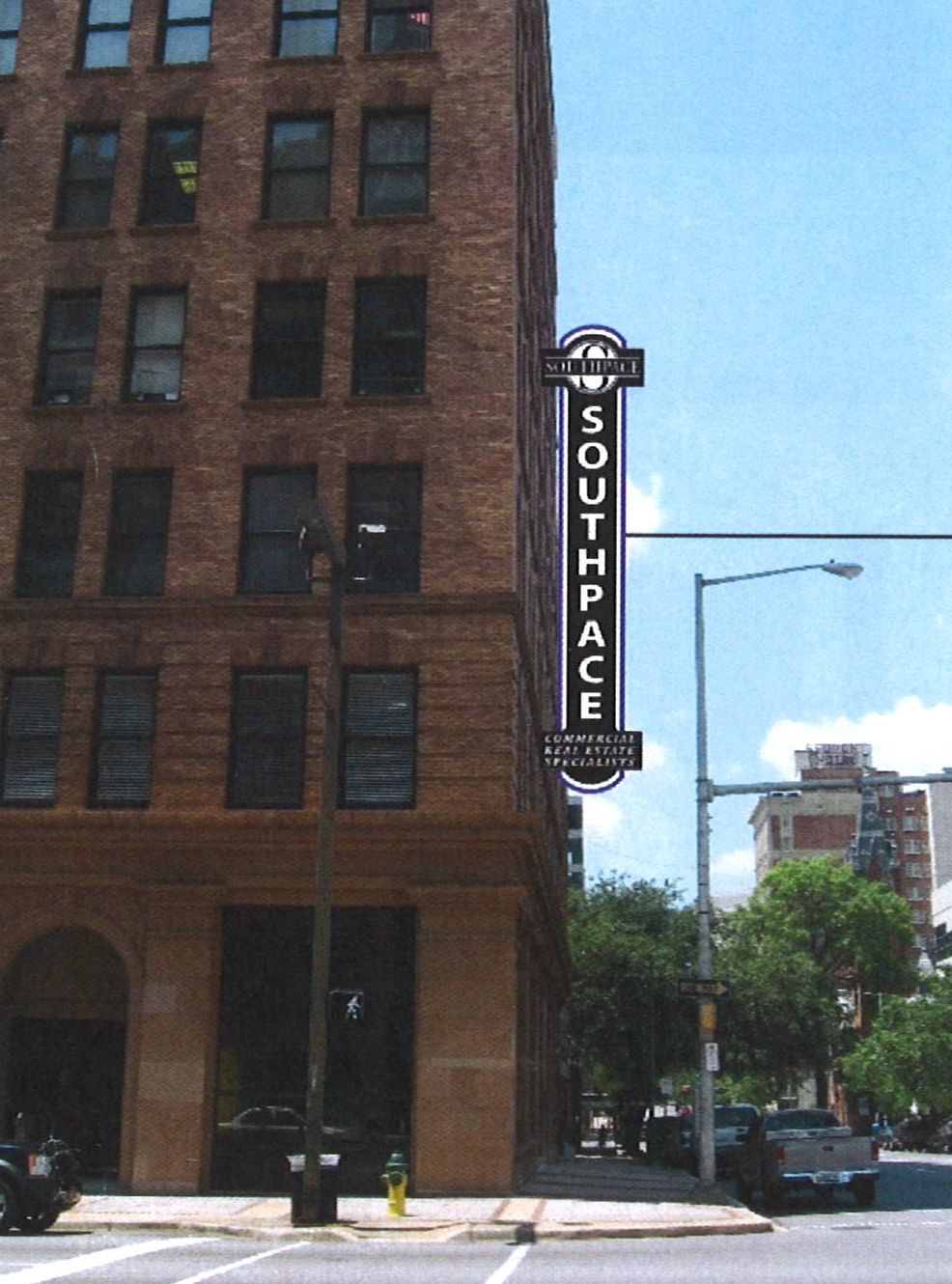
This morning at Design Review Committee, several sign packages were approved. Above is a rendering of the new illuminated, projecting sign for Southpace Properties, the commercial real estate firm located in the historic Title Building at the corner of Richard Arrington Blvd. and 3rd Avenue North. Slogging out of a brutal recession that’s been crippling to the commercial real estate market, this sign is a hopeful indicator that firms like Southpace intend to stick around and that development will continue. The proportion and illumination mimics the original projecting signs installed in the 1920’s on this building; its unanimous approval signals a welcome reversal to the city’s aversion to projecting signs which started in the 1970s (it became fashionable to consider projecting signs old-fashioned and messy). If they’re designed nicely, and proportional, projecting signs are an important part of the urban fabric. Downtowns look blank and forlorn without them.

A big investment on a big corner

Above is the approved awning and signage package for the front of MetroPrime, a new steak house and bar in Five Points South right on the circle, in the former location of the Mill restaurant. Described as an upscale steak house, the restaurant will also feature a casual bar/cafe side with its own, lower-priced menu. After several half-hearted attempts to open slightly revised versions of the Mill over the last few years, it’s exciting to see a totally new concept for this crucial corner. The large outdoor patio will remain open for dining. Plans are to be open by August.

Back to the boards

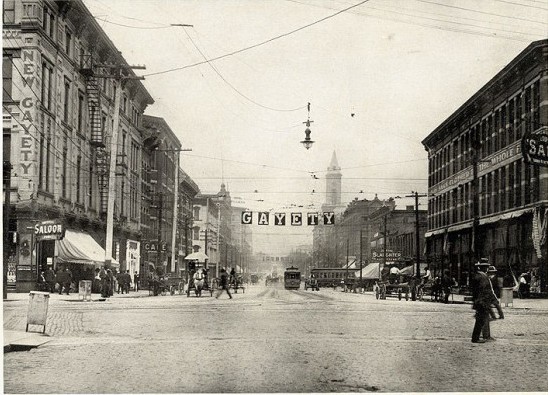
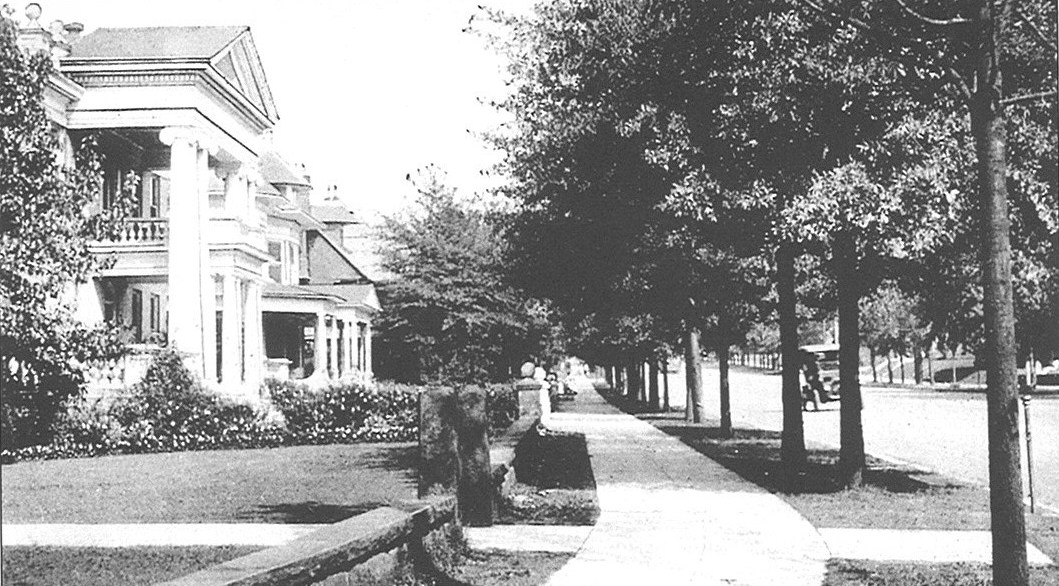
On a final note, the committee rejected Corporate Realty‘s plan to paint the former Saks building (pictured above to the right, in 1908: you are looking north along 19th Street North with First Avenue just ahead) in shades of grey and white. The red brick building, accented with cast stone and metal, is in very good condition and the committee objected to its character being simplified and homogenized by the paint scheme. Perhaps it would be ideal to clean the existing red colored paint from the red brick, and leave the existing details distinct.

[thanks to Southpace and Reliable Sign Services for the sign rendering, MetroPrime and CityVision for their rendering, and Birmingham Public Library for the historic image]

Delivering the message

Of which urban pleasure shall I partake today?

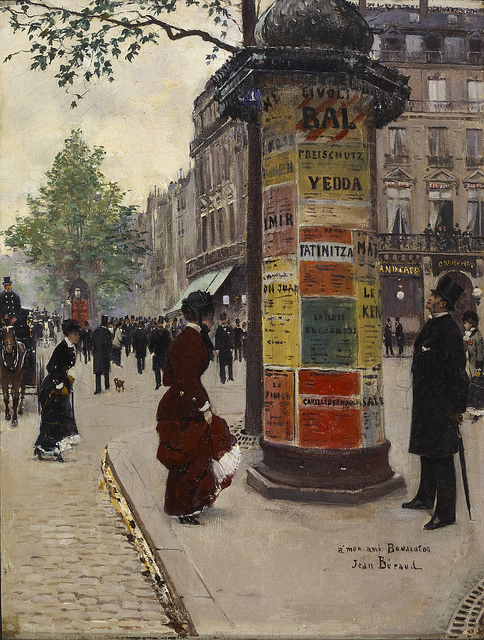
Branding and signage are essential aspects of any successful urban environment. The above painting by Jean Beraud, 1882 shows one of the famous Paris kiosks which not only provided advertising space in a newly urbane and consumer society, but provided a strong Parisian brand: when you see this kiosk, you think “Paris street.” Birmingham has not done a good job branding itself–a pity since there are talented graphic designers here, and places worth branding. Reflecting the fact that the city as a whole has struggled with how to project its own image, we are often disappointed by the lack of good, local public-sphere branding around here.  This past couple weeks have brought a few examples to the fore.

Huh?

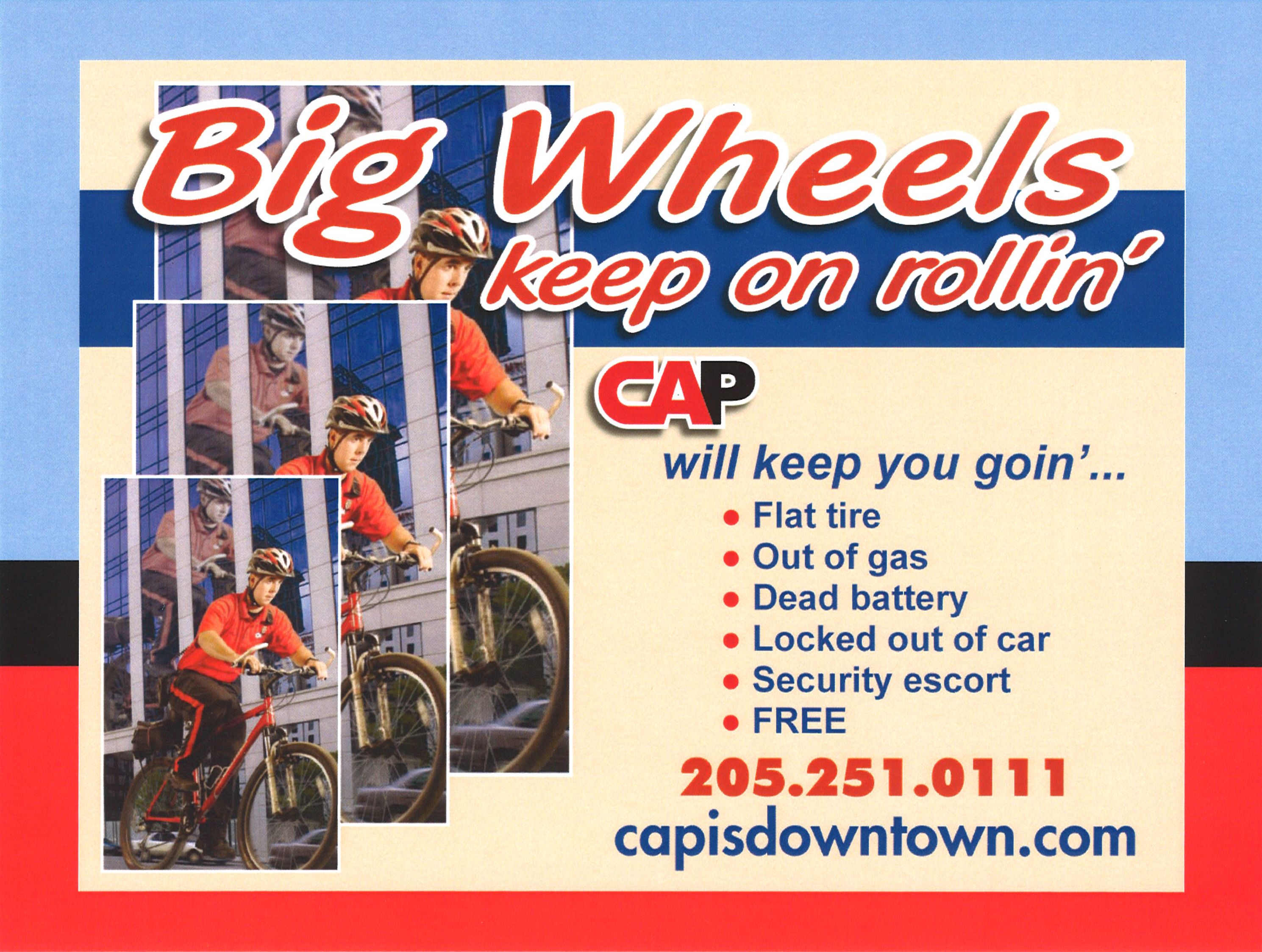
First, a couple items that were denied at Design Review Committee last week. The above is a proposed 15 x 20 foot banner (that’s big) to be located on the alley elevation of John’s City Diner on Richard Arrington Blvd. North, advertising the services of City Action Partnership, or CAP. This great organization provides supplemental security and motorist assistance to downtowners–and has certainly been instrumental in making the downtown core one of the safest neighborhoods in the metro. Advantage Marketing presented this design to advertise CAP–but it was sent back to the drawing board for being too incoherent for the average person to understand. The image is confusing; the “Big Wheels” seems to be advertising something else altogether; the font sizes aren’t balanced, etc. CAP does too great a public service; it deserves better design to communicate their mission. And the public deserves something much better to look at.

Begging for identity

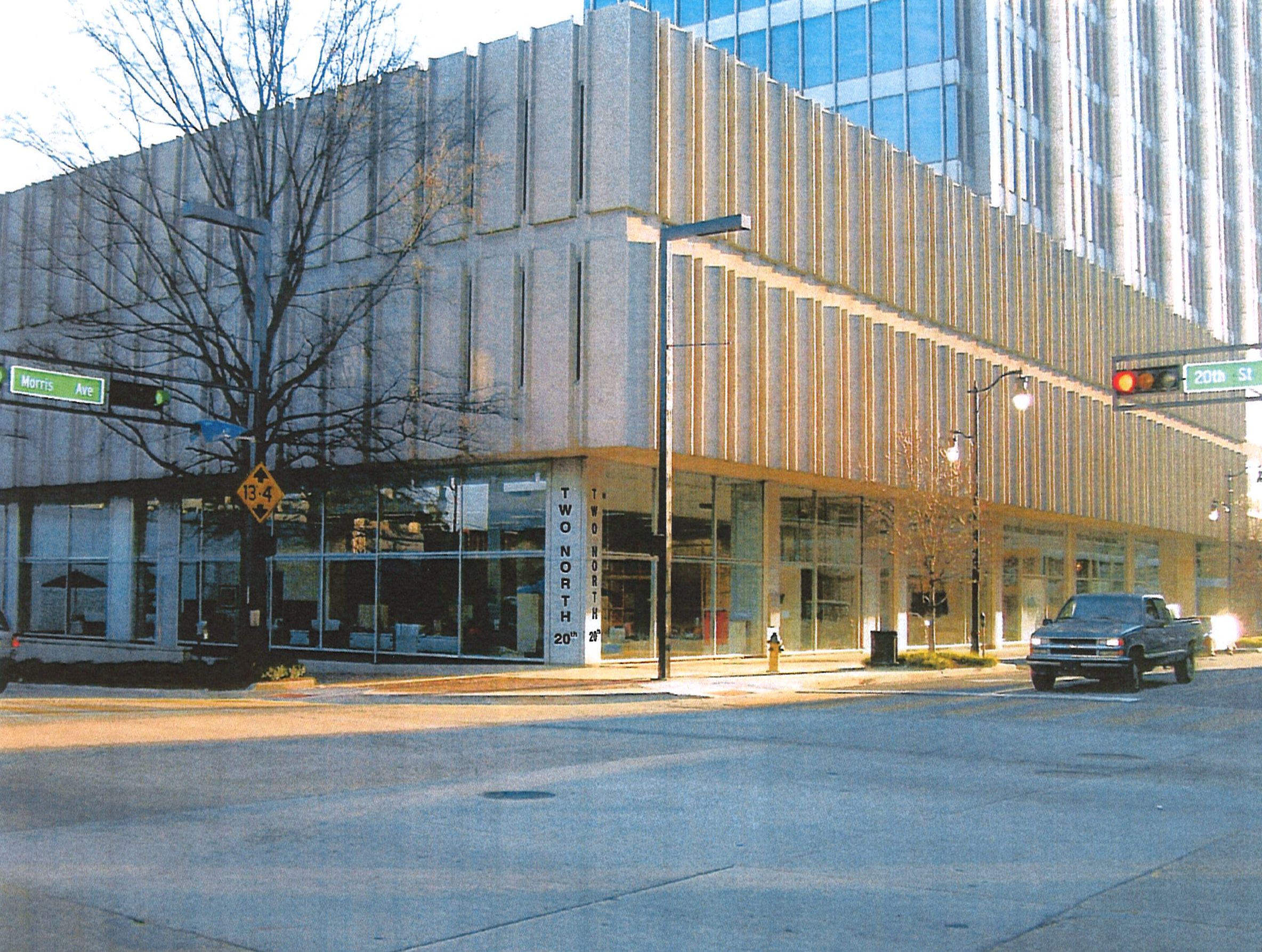
Next up in the denial section was the above–a proposed new illuminated sign at the corner pier of Two North Twentieth, the former Bank for Savings Building at the corner of Morris Avenue and 20th St. North. This iconic building from 1962 is the City’s most prominent example of International Style architecture, following in the footsteps of the groundbreaking Lever House on Park Avenue in New York (1952), and a decade of countless copies across the nation (and world). It has never had any signage identifying the building  near ground level (many know it from it’s giant, illuminated advertising marquee on the roof). Not only is the proposed signage uninspired, but it doesn’t even match the building’s logo (itself a tepid, uninspired moniker): “20th” is not spelled out like “Twentieth” which is the actual name. The committee sent this one back to the drawing board too. I hope that a cool, illuminated, and creative solution that works with the rhythm of the concrete panels on the second floor can be devised. This building and this corner need good signage, not haphazard non-design.

Huh? Again

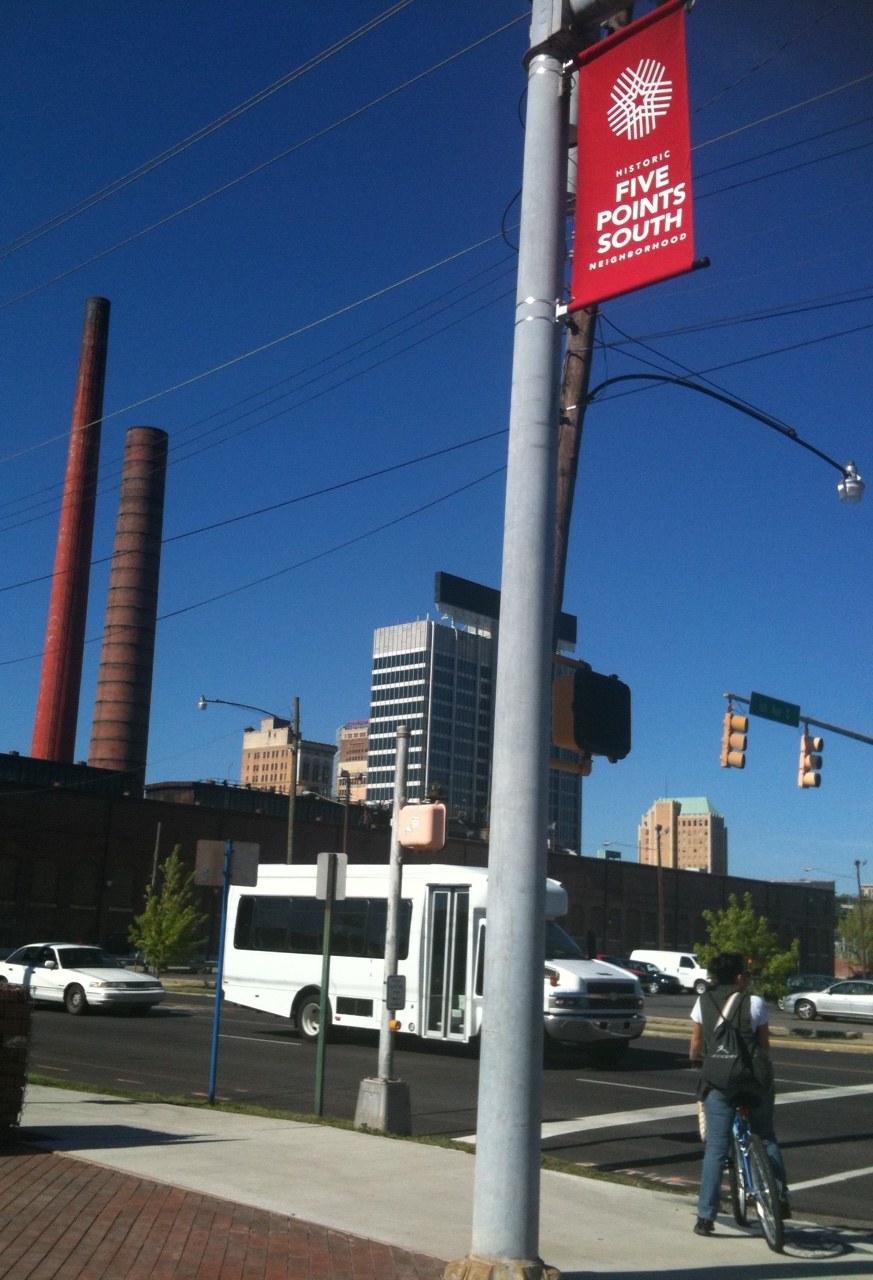
A different kind of mismatch is found at the approach to Railroad Park, where recently banners announcing the Five Points South neighborhood went up. Yes, the Five Points neighborhood stretches all the way north to the railroad tracks. But as a tourist destination and mental construct, Five Points is the area directly around Five Points Circle. It is confusing to say the least, to see these banners when one leaves the new Railroad Park–whose immediate neighborhood has already been envisioned as a distinct entity for redevelopment and marketing purposes (tentatively called Parkside). Showing these banners a dozen blocks away from Five Points Circle is not the right way to go. We should be developing a final name and logo for Parkside (contest, anyone?) and putting those banners up. They can even say in smaller print “part of the greater Five Points Neighborhood” if necessary. Of all areas, this location needs more focused branding, not territorial marking. The money for Five Points banners should be spent on kiosks or other needed items near the Circle itself.

[Sidebar: right across the railroad tracks the Fountain Heights neighborhood extends all the way from the bungalows north of downtown south to the edge of Railroad Park. But does anyone really consider, besides City committees and attorneys, McWane Center to be part of Fountain Heights? Of course not, it’s in central downtown and desperately needs its own sub-neighborhood brand.]

Please, please, I'm desperate for proper branding

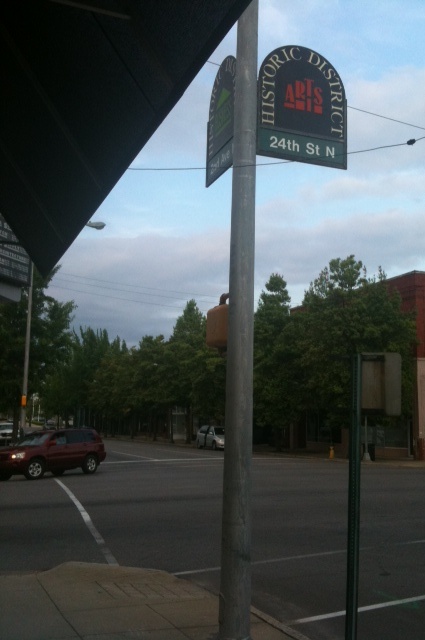
Which brings us to our last comment: just like the new neighborhood around Railroad Park that deserves its own brand, other parts of central downtown are long overdue for the same. Other cities large and small–from Portland to Austin to little ol’ Mobile–have branded neighborhoods downtown to great effect: banners and publications use the logos, people say “I’m headed down to —” or “great new lofts are opening in —“. Here all we get is a vague “downtown” or “loft district”–fairly indistinct terms. Just look at what passes for branding in the so-called “loft district” above–signs put up perhaps in the early 1990’s which, in a classic branding nightmare, state “Historic District” with the words “Arts” “Business” and Lofts” interchangeably used on different faces. Which Historic District? Business??? Really? These terms are meaningless. The 2nd Avenue sub-district needs boundaries, a logo, and a name. Downtown should be sectioned off so that lofts east and north of Morris are in NoMo; those west of 20th are in West Central, etc. I am just making up these names–branding experts do this sort of thing much better and all the time. We need to make it happen soon.

Whether neighborhood or building signage, this City needs to demand better branding. It’s one of those things that you take for granted until you see how much sharper it can be in travels to different cities. We have the local talent. There are great examples around of their work. We just need much more. Employ them!

Stay tuned for a post on some of the great public-sphere signage that we do have around here.

[thanks to mbell1975 for the Paris kiosk pic]

Five Points Reviving

Saved

Great news from Design Review Committee this morning: the historic Daniel-Hassinger mansion at 2028 Highland Avenue South, one of the few surviving original houses in Five Points South, will become a new bed-and-breakfast, the Daniel-Hassinger Bed and Breakfast. The owners, Sheila and Ira Chaffin, who also recently renovated another nearby historic house into a similar facility (Cobb Lane Bed and Breakfast), plan to open May 2011. It will have 10 guest bedrooms.

Birmingham has long had too few (if any)  historic B&B’s, despite the wealth of historic housing stock here. Kudos to the new owners for not only bringing 2 of these to Five Points, but for rescuing this elegant, deteriorated mansion whose condition we worried about in a recent post.

Projects like this serve as hope that, despite its challenges, Five Points South can still attract entrepreneurs and great new businesses. Needless to say, the Design Review Committee was practically cheering when the unanimous vote was cast. There’s more to report from this morning, but this was the biggie.

[thanks once again to dystopos for the pic]

The fraying fabric of Five Points (2)

Really?

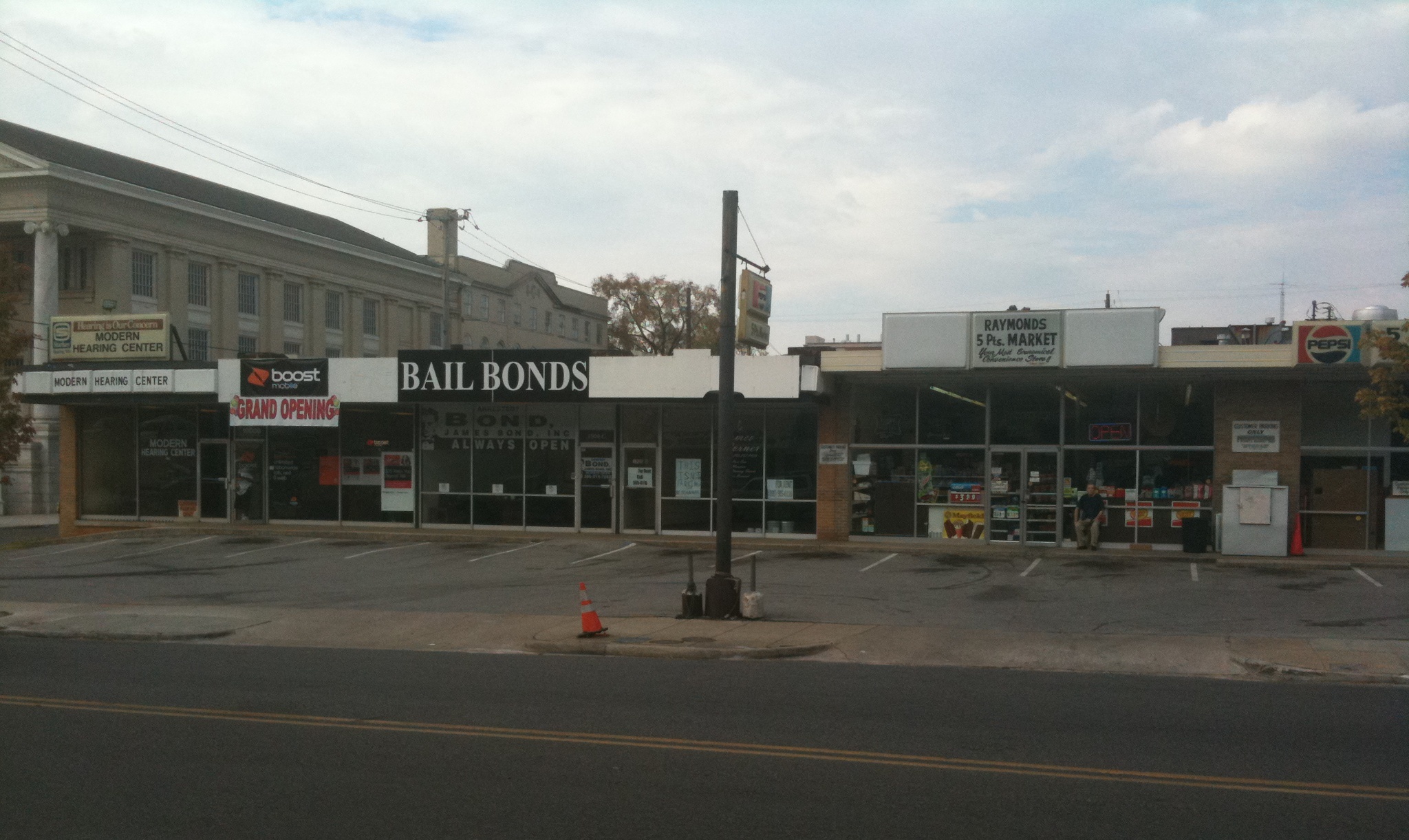
In the second article about the critical period Five Points South is going through right now, the above image should give everyone pause. It seems not too long ago, this little strip mall on the 1900 block of 11th Avenue South was home to a longtime hairdresser, hot dog stand, and convenience store, as well as an H and R Block. The convenience store remains, but the hot dog stand is closed and cardboard boxes and rear ends of display cases block the plate glass. A vacant storefront has a “This is not parking for restaurants” sign menacingly scrawled, amidst other cheaply done, temporary signage. In fact, the cacophony of old and new signage, “temporary” banners and posters, and the overall complete lack of street presence makes this surely one of the most shameful urban presentations in Five Points.

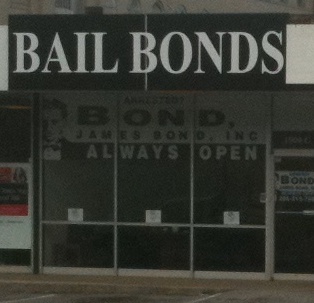
Worst of all is the new “Bail Bonds” sign, in horrific black and white, with an incredible graphic pasted across the storefront stating “Arrested? Bond, James Bond, Inc. ALWAYS OPEN”. Is this for real? Did it really get approved by Design Review? Here’s a detail of this storefront below:

...and again, really?

If ever there was an example of the need for a redevelopment authority, which years ago could have acquired this property and solicited for redevelopment more appropriate for the neighborhood, this is it. As it is, the property and its tenants have really sunk to a new low, and it’s depressing. I mean, Bail Bonds? In the middle of Five Points? Not exactly the image we’d like to convey in the metro’s center for dining and nightlife.

On a more positive note, the local merchants (and there are many wonderful merchants who keep us optimistic about the place) have formed a committee to address “immediate tasks and long term goals” for the area. There’s a piece in the Birmingham Business Journal on this announcement here.

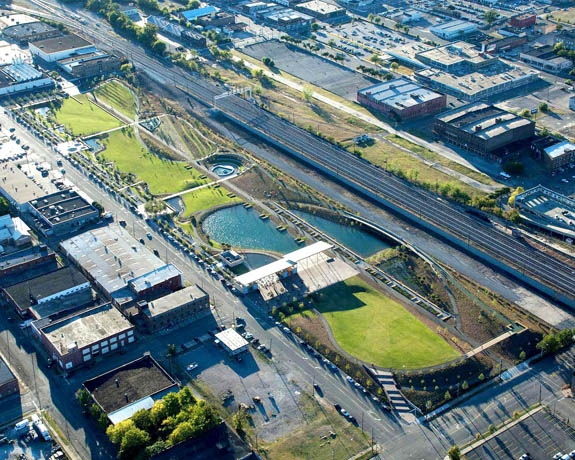
And on another positive note, unrelated to Five Points but a few blocks south–a friend alerted me to the fact that Tom Leader, the Berkeley, CA-based landscape architect responsible for the design of Railroad Park, now features that park on the front page of his website. Here’s one of the aerial pics you can find on his project page, showing the elegantly layered design of the park from above:

let's densify the edge and connect it with bike paths!

So far the main complaint I have about the park is the lack of sidewalks bordering it on 1st Avenue South (hopefully they are coming soon!?!). Oh, and one more complaint–that greenways/bike lanes aren’t already in place making it easy to reach this incredible space from across the city by bike. Regardless, I’ve been there almost every day or night enjoying it (walking or biking from home), and it looks like the rest of the City is too. That gives me hope after a grim meet-up with “James Bond” up the street.

[Thanks to Tom Leader Studio for the aerial pic]

The fraying fabric of Five Points Alert (1)

Among the last of an era

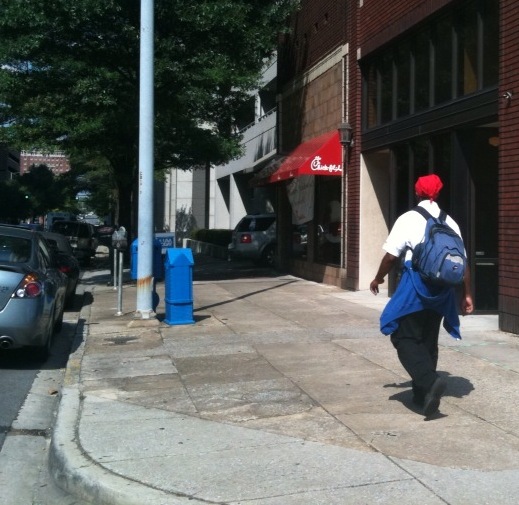
Walking through Five Points South yesterday I was struck by the number of vacancies, the “for sale” signs, and then it hit me — we are at a very crucial time.   I think back 10 years ago when, heaven forbid, there was talk of chain stores (Gap, Blockbuster Video) moving in.  Now that many independent retailers are gone anyway (with some very important exceptions! iii’s anyone?),  and a Chick-Fil-A is the biggest recent news story, we are facing a difficult period.  This should be a jewel of our downtown.  Restaurants, bars, retail — all capitalizing on the huge adjacent UAB population.  But it’s not living up to this potential.

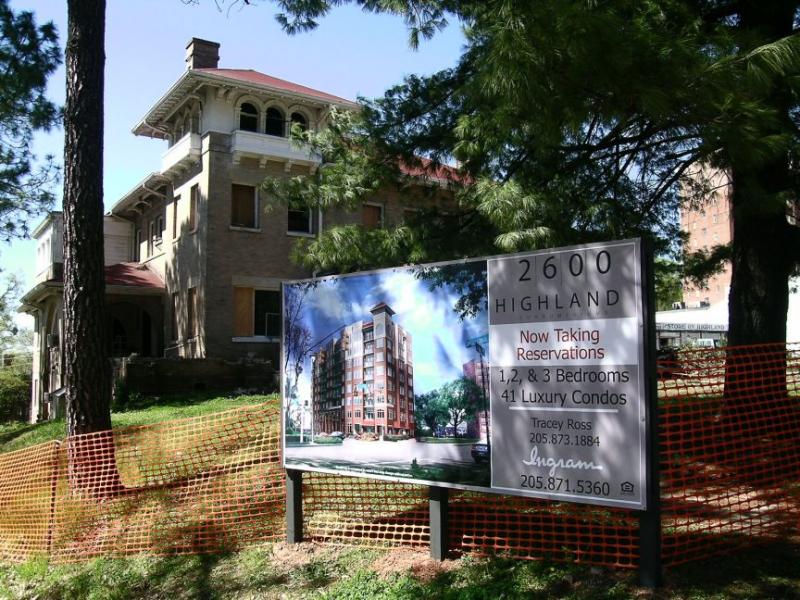
Seeing the furniture and detritus on the front porch of the Hassinger home, a gorgeous grande dame of Highland Avenue adjacent to the new Chick-Fil-A development (the elderly lady living there has departed), I am reminded of what happened to the Otto Marx mansion further down Highland a few years ago, when a unique, historic structure was torn down and replaced by a new structure that could have easily gone somewhere else:

A piece of history falls before the mighty hand of the market

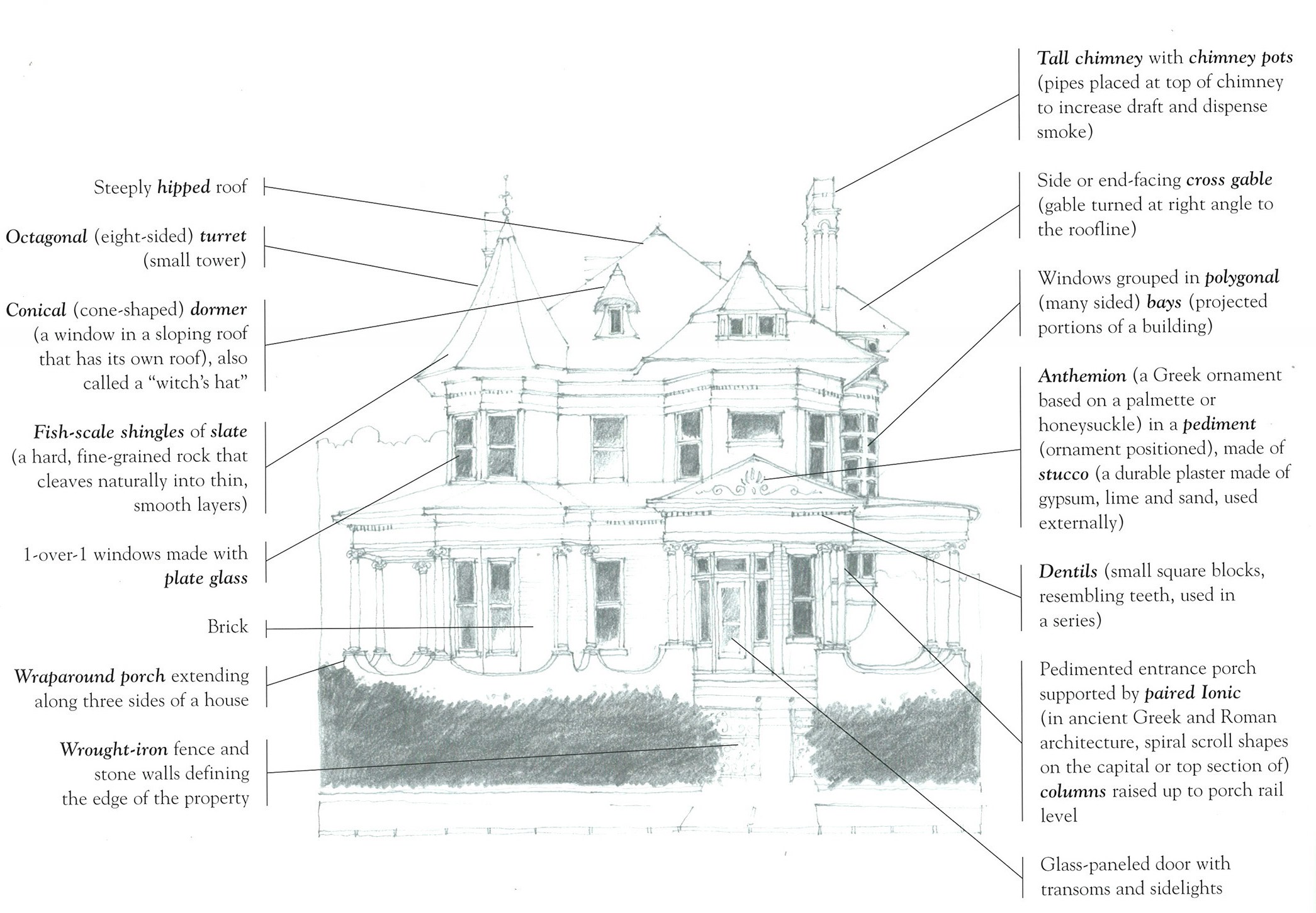
In 2003, the Alabama Historical Commission and Alabama Preservation Alliance added the Hassinger home to its “Places in Peril” list, and rightly so.  This is an excellent example of the Queen Anne style as noted in the Birminhgam Historical Society‘s Guide to Architectural Style:

Illustrative purposes

So many of the homes that once lined Highland Avenue have been torn down in the name of progress, or left to fall apart until there was no other choice.  As readers may know, I am a big proponent of diverse communities with lots of architectural choices. But when you only have a handful of historic houses left in the City like this, the choice is clear. We need to preserve.

The way it was

What could this site be? A fantastic bed and breakfast with a welcoming front porch for visitors.  A bookstore.  Or, to dream big, quality retail, similar to how the Rhinelander mansion in NYC was saved to create the Ralph Lauren store on Madison Avenue:

Could be perfect for prepsters

[thanks to dystopos for the Hassinger House pic; lsyd for the Marx/Sales sign pic; Birmingham Historical Society for the diagram of the Hassinger House; Jefferson County Historical Commission for the 1910 view of Highland Avenue, and sruellen for the Ralph Lauren pic.]


Dead customers can’t buy a lot of chicken

At yesterday’s working session of a subcommittee of the Design Review Committee, Chick-Fil-A came back once again with a revised proposal for the heavily trafficked NE corner of Highland Avenue and 20th Street South in the heart of Historic Five Points South.
A move in the right direction, but not enough

A summary of the session can be found in the News here, or over at Second Front here. Suffice it to say that while the site layout–and the drive-through’s impact on the layout–is still a serious concern of the subcommittee, the design of the building itself has undergone a sea-change from earlier versions. Local firm Cohen Carnaggio Reynolds has been hired by Chick-Fil-A to try to win over hearts and minds. What exactly is at issue with the design of the building?

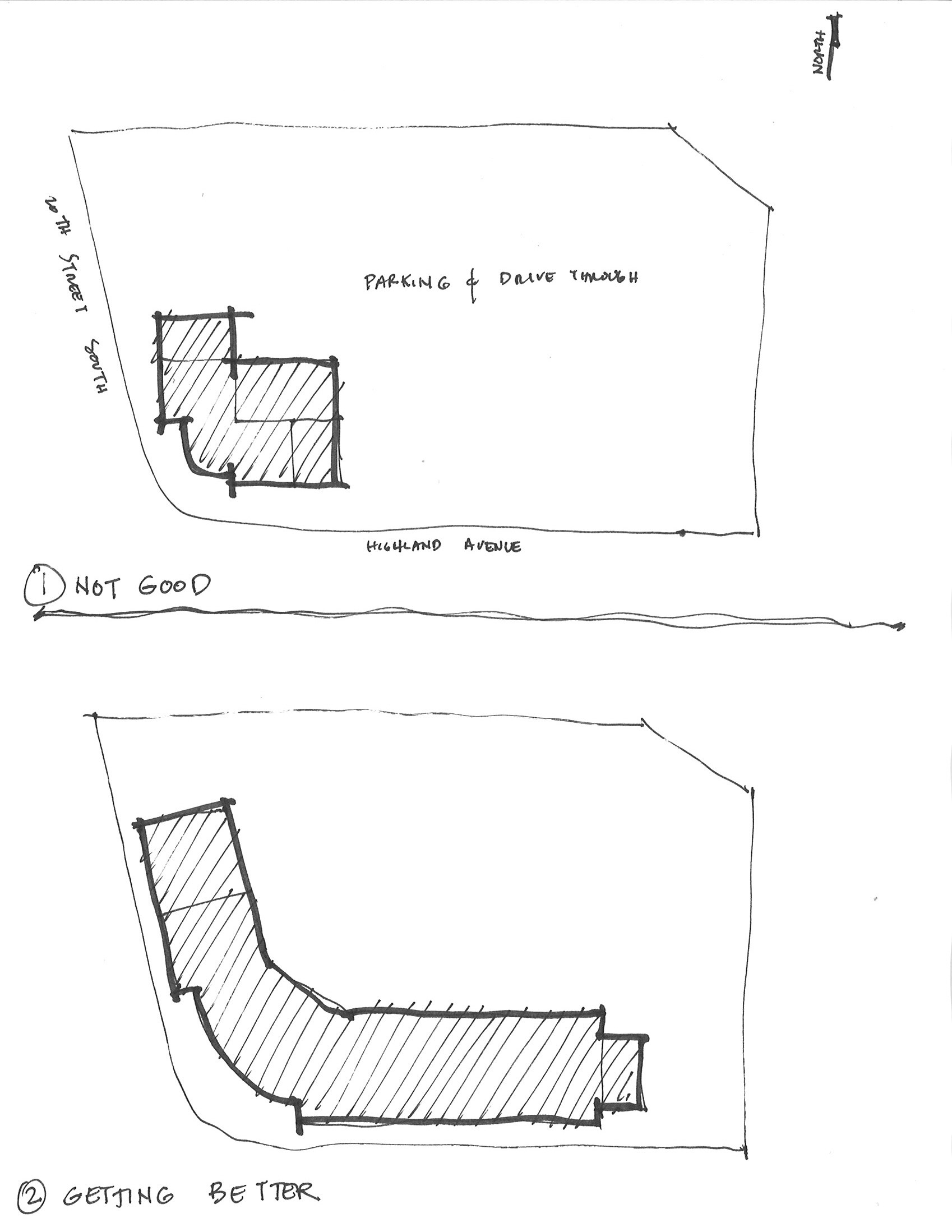
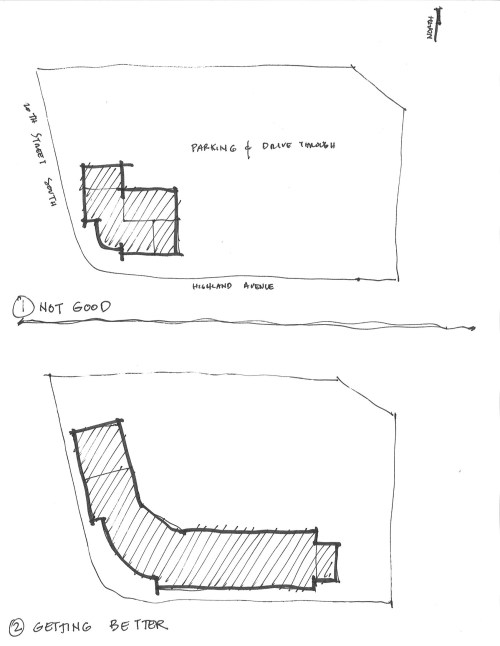
The quick sketch above roughly illustrates the difference between earlier schemes–which showed a typically suburban “outparcel” site strategy (#1 above)–and the current scheme presented yesterday (#2 below). Whereas before the building mass was dwarfed by the relative sea of surrounding asphalt parking (and drive-through), now the building has been elongated to take up over 80% of the street frontage on both streets. The parking and drive-through are now fairly well hidden from either street. (Please note these sketches are not to scale.)

From an urban standpoint, this is a good thing. Urban neighborhoods depend on density for their success as dynamic environments. It’s pretty intuitive: how many of us have visited a dense environment like Manhattan and walked a mile without noticing? Whereas in a less dense environment, like most of Birmingham, most of us really notice–and avoid it–if we have to walk more than 1/2 block to a destination. When we don’t have a dense, vibrant, interesting wall of buildings fronting the street to hold our interest and make us feel secure, we don’t want to keep walking. Brightly lit storefronts keep us walking; big parking lots don’t.

How did the architects stretch out this new, 291 feet of facade? While actual floor plans were not presented, it appears that a lot more seating was added–both interior and exterior, some under a covered pergola. And how did they respond to the Appeals Board’s decision to deny Chick-Fil-A in part because the building previously presented was clearly purpose-built for Chick-Fil-A, rather than as an adaptable commercial structure more typical to the area?

The response was to offer several possible versions of how the building could look. In each one, the building was imagined as a simulation of organic growth over time, dividing up one facade into 3 parts, with each part resembling a somewhat different building. While this sounds reasonable in concept, it is very hard to pull off, especially if the same architect is designing the entire project. Simulating architectural diversity that normally occurs organically, and over time, often results in a “Disney Effect”, where the street ends up looking like a stage set.
A simulacrum of the real thing

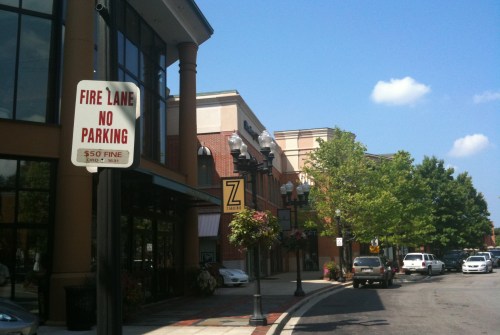
Take the outdoor street and commercial “facades” at Brookwood Mall, pictured above. While the design has certainly improved the mall from a planning standpoint–opening shops onto an outdoor sidewalk, facing new restaurants, with parallel parking and street trees mimicking an actual urban street–the architecture itself is disappointing. Because despite the effort to modulate the elevations, with different heights, setbacks, and architectural “styles”, the whole thing still looks like it’s one big mega-project that came from the same hand. Why? The level of detail is consistent; while from facade to facade the brick may differ from the stucco, and the impressed tiles differ from the cornice, overall there is a similarity in both material and design quality that makes the experience more homogeneous than diverse. If the developer had one master plan, and hired multiple architects to create the facades using certain guidelines, then the results would have had much more potential. Of course large-scale commercial development rarely goes that way.

Rather than simulate 3 buildings, I think it would be more fruitful to consider one consistent building, and vary the scale along the facade to achieve a certain diversity and rhythm.
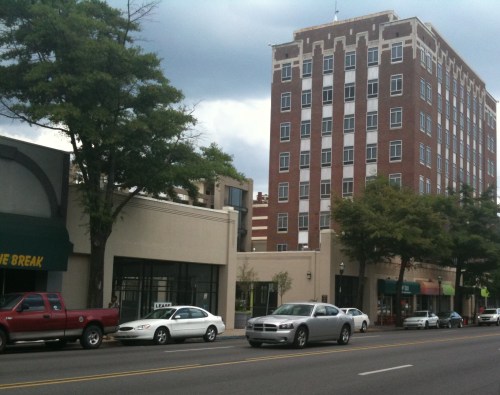
A post-modern infill down the street

Interestingly, the Committee towards the end (with Cheryl Morgan leading the discussion) urged the architect to not depend on historic precedent to such an extent that the buildings look like imitations of Spanish Revival or Art Deco, two common styles of the Five Points area. “Contextual” and “Compatible” do not mean “Imitation”; Morgan pushed for a “21st century solution” that, while clearly new and  of this time, responds in a respectful way to the scale, rhythm, and massing of the eclectic neighboring buildings. Too often when new buildings are designed to be “Tudor” or “Spanish Revival”, modern budgets and available craftsmen make the details very disappointing compared to the models of 100 years ago. Above you see an example at Pickwick Place a couple blocks north of the proposed site, where an infill project in the early 1980’s gave us stucco facades with end piers and grooved details meant to evoke the 1930’s Art Deco of the Pickwick Hotel to the south–but while the massing feels right, the paucity of detail, the banal storefronts, and the cheap looking light standards, clumsy railings,  and ugly metal coping all say “1980’s on a budget.”
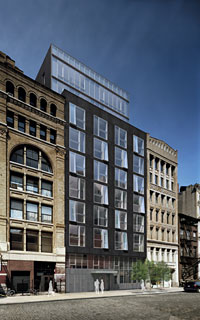
21st century contextual

This residential project at 48 Bond Street (designed by Deborah Burke) in New York is an example of a confidently modern infill structure that manages to respect and respond to its neighbors without imitating them. It matches the parapet heights of its neighbors, recessing its additional stories back from the street line; it uses proportion and material to relate without copying. And frankly, even with New York budgets, copying historic elements is almost bound to disappoint once you start designing details. And details can make or break a project–as Committee member Mark Fugnitto stated, the details will determine whether the proposal is a good or bad building. And, as this is still a work in progress, we  don’t have the details yet.

Another example of sensitive modern infill architecture that doesn’t try to imitate the past is the Portland Harbor Hotel annex below in Portland, ME. Designed by Archetype, this project proves you don’t have to build a corporate template, or imitate the past, or simulate diversity, in order to create something both substantial and adaptable to other uses in the future.
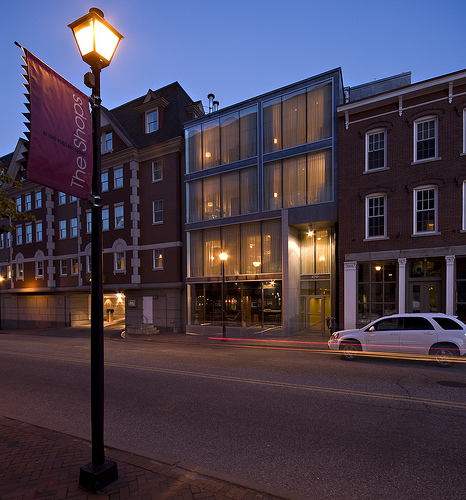
Elegant and substantial

Now, what still remains–and what the architect can’t fix no matter how hard she tries–is that Chick-Fil-A is still hell-bent on a drive-through, on a single-use for the entire site, and of course on their no-Sundays policy. I think all 3 of these represent big flaws to the development of the site.

First, a drive-through is incompatible in this neighborhood.  Chick-Fil-A’s traffic engineer stumbled a bit yesterday when he finally acknowledged that the famous “47 second” average drive-through wait–“the best in the business”– was actually 47 seconds from placement of order to receiving that order. You can wait much longer to get to the box and ramble through the order itself. So at peak times, it is all too easy to imagine the stack of cars spilling out into the parking area and creating traffic hell all around the site, which is already hellish enough. Couple this with the fact that people are not getting out of their cars like everyone else in the neighborhood and walking to their destination makes me–and most of the committee–still skeptical that the drive-through can be proven compatible with the neighborhood. [A friend of mine just timed his drive through experience today at the Eastwood Village CFA location and clocked 374 seconds total from entry to exit–and this was a good 20 minutes before CFA’s stated “peak time” of 12:15 to 12:45.]

Second, while it’s admirable that the company is now willing to reduce total number of parking spaces, and simulate multiple storefronts across a wider street frontage, this is no substitute for true urban diversity, with multiple businesses located adjacent to each other. This prominent site is much better suited for mixed-use than for single-use, and while CFA admits they have “more property than they need”, they refuse to entertain the idea of subleasing out a portion to another business. Hardly surprising, but still disappointing (and disappointingly beyond the purview of the Design Review Committee).

Finally, while somewhat unspoken (and again beyond the DRC purview), it is truly a shame that, because of CFA’s policy of not opening Sundays, this important intersection in one of the most popular urban destinations for locals and tourists alike would be completely dead for a full half of every weekend. Not the schedule you want in one of the few dense, around-the-clock neighborhoods we have in this city [Pancake House: you need to open for dinner!]. And speaking of the Sunday closing: CFA is known for hiring only clean-cut workers with proven “family values”; its corporate office financially supports such groups as Focus on the Family, a controversial organization that campaigns against gay rights among other things. The fact that the Five Points neighborhood is one of the most demographically diverse and accepting in the entire state at the very least lends an irony to CFA’s desperation to be there.

When the traffic engineer was grilled on vehicle counts and flows, one objection was conflict with pedestrians at various points around the site. His reply was that of course CFA wants to avoid pedestrian accidents: “Dead customers can’t buy a lot of chicken.” Oddly enough, that quote seems like a good way to sum up this entire effort thus far. Stay tuned.

[thanks to KMGough for the Portland infill; Deborah Berke for 48 Bond Street]

Design Review Alert

The Design Review Sub-Committee will hold another “working session” with representatives of Chick-Fil-A to “review Chick-Fil-A’s latest design proposals” for a new restaurant on the corner of Highland Avenue and 20th Street South in the heart of the Five Points South Historic Neighborhood.

The meeting will be Tuesday, July 20, 2010, at 4 PM in the 5th floor conference room at City Hall, and is open to the public. However, unless requested by the Sub-Committee, no public comments will be taken, and seating is limited in this conference room. For those who cannot attend, I will do my best to report the proceedings.

No rulings are made at the working session.

Details, details

A lot of our time recently has been spent on big issues: form based code, new urbanism, corporate footprints within historic neighborhoods, major public greenspace. It can be equally useful to examine the myriad small details that go into our built environment–the ones that are often taken for granted.

Today’s Design Review Committee meeting was a good place to reflect on these small things (and the hard work–often thankless–that this volunteer committee puts into all considerations, large and small).

Signs of the (changing) times

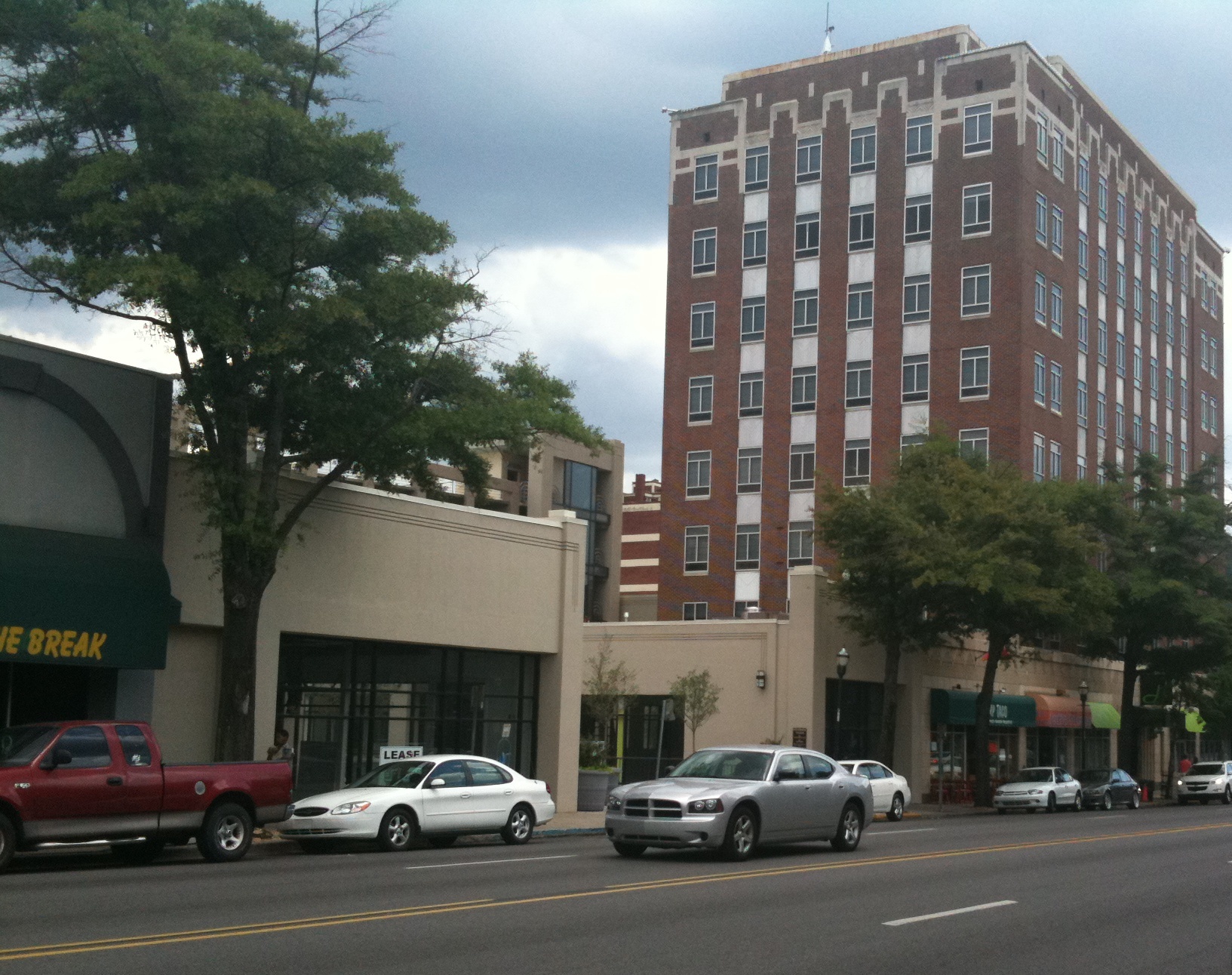
The Wachovia Tower (formerly the SouthTrust Tower, shown above right a few years ago before that merger with Wachovia) is now the Wells Fargo Tower. Executives from Wells Fargo presented a proposal to replace the current abstract Wachovia logo (approximately the same size as the old SouthTrust “S”) with a much larger “Wells Fargo Bank” that stretches across the blank, dark spandrel glass of the penthouse, repeated on each of the four sides. Noting the importance of the chamfered penthouse corners, the Committee asked for just a few feet of breathing room to either side, slightly reducing the size of the sign. After the WF people initially objected–claiming the sign as presented was the perfect size to be seen “from all the major interstates”–they bowed to the reasonable assertion that the sign should be proportionally correct to the building and pleasing to the eye for pedestrians, not just stressed-out commuters on the freeways. Who, as Committee member Cheryl Morgan pointed out, should really be “concentrating on driving” rather than gazing at distant signage.

Illuminated signs (and this one will be lit with expensive, but energy-saving LEDs) are important symbolic markers on a skyline. I’m happy this building–whose branding has long suffered with tiny, illegible logos, is now getting a well-proportioned, clear sign that lives up to the importance of the southeastern headquarters for a major national bank. And I’m happy the Committee insisted on a very small, but important adjustment–improving the view of this sign from the surrounding streets and windows in the CBD.

Clever retro aesthetic

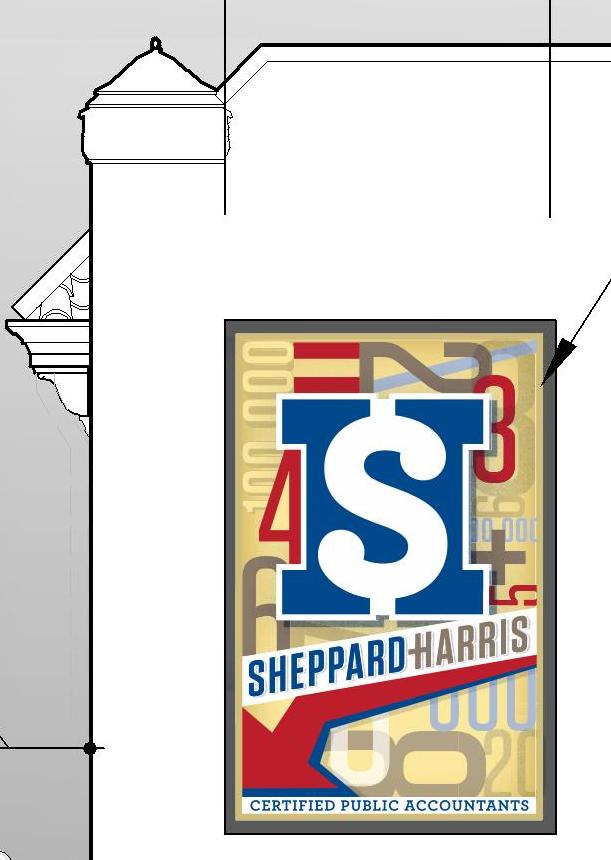
There were also two other, similar cases, both again involving signage. One, for Sheppard-Harris and Associates in Fire Station No. 4 in the 200 block of 24th Street North (my firm designed the exterior renovation), won approval for both a new projecting (blade) sign which will illuminate at night, and a new, painted mural sign at the blank side of the building facing a parking lot along Third Avenue North (shown at left).  Dog Days of Birmingham, in the 100 block of 18th Street North in the old Hunter Furniture building  (which was discussed earlier here), won approval for a new blade sign but was denied approval for a painted sign on its side wall facing First Avenue. Their proposed painted signage did not show much artistic creativity (in contrast to the Fire House sign, designed by The Modern Brand), which in part led the Committee to judge it banal and redundant given the prominence of the large blade sign around the corner. I’m a big fan of signage downtown–a full post to come on that soon–so I hope that we can see a new proposal for a more thoughtfully designed painted sign at this location.

Some other items:

1. A crude picket fence (in lieu of a proper railing) constructed without a permit at a porch of an historic Highland Park house that the Committee agreed should be replaced with something more appropriate to the house;

2. A new landscape plan for a small parking lot directly east of the new Marriott Residence Inn in Five Points South whose landscaping and paving plan was passed–but whose many, excessive “No Parking–Tow Zone”-type signs strewn across the site were denied;

3. New wood replacement windows in the Blach’s Building annex in the 300 block of 20th Street North (to accommodate new loft apartments planned for that building) that the Committee easily approved;

4. A renovation plan for the new Naked Art gallery in Forest Park commerical center, unanimously approved;

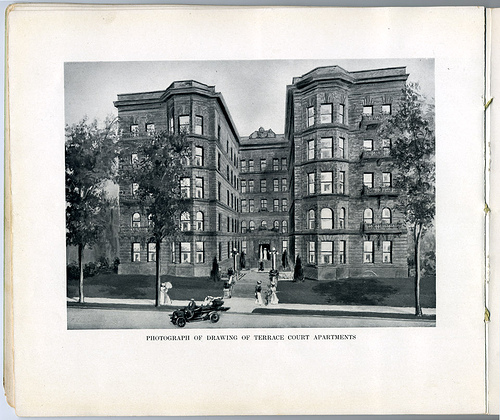
5. And a somewhat ingenious steel-framed parking deck slotted behind 11th Avenue South to service the newly renovated Terrace Court Apartments (and the general public) in Five Points South, designed by Cohen Carnaggio Reynolds–also unanimously approved.

All of these small-ish items aren’t big-ticket controversies or complex designs. But added up, these small bits (along with the larger and/or more prominent projects) help make our city’s environment special. One more pat on the back to the Design Review Committee for slogging through every item, however small, with an eye towards helping improve Birmingham’s built environment.

No parking deck required back in the day

[Full disclosure–the vote for my signage package was not unanimous: Chairman Sam Frazier cast the lone vote against, objecting to the blade sign illuminating at night. While perhaps unusual for a CPA to have illuminated signage, I felt it important in the burgeoning, (almost) 24-hour 2nd Avenue neighborhood for the company to have a night-time presence.]

[thanks to hannerola for the SouthTrust pic and Dystopos for the historic Terrace Court pic]

Chick-Fil-A: we’re back!

Still trying to make a suburban model urban

I found out at very late notice that a subcommittee of the Design Review Committee was meeting today at City Hall in a working session with representatives of Chick-Fil-A, to discuss a revised proposal for the prominent site at the corner of Highland Avenue and 20th Street South in the heart of Five Points South. As many already know, their previous proposal has been denied twice: once by Design Review, and once by the Appeals Board just a couple weeks ago.

So it was with great interest that I hurried to the meeting to observe the proceedings.

First, subcommittee chairman Richard Mauk laid out the guidelines–that the subcommittee expected Chick-Fil-A to respond to each of the points laid out by the Appeals Board. The implication was: if you don’t address each point, then you don’t have much chance of success with a new presentation.

Chick-Fil-A started their presentation, once again using a site plan showing no surrounding buildings or other neighborhood context. This is Presentation 101, especially when you’ve just been raked over the coals for not being sensitive to the neighborhood. Besides the lack of context, the site plan was most notable for still containing a drive-through, and for still containing the same basic proportion of building mass to open parking (2 of the main concerns of both previous “No” votes).

While the Chick-Fil-A in-house engineer was attempting to explain the plan, committee member Don Cosper asked why the location needed so many parking spaces when only 21 are required by code [almost every surrounding business has a variance on parking and very few have on-site parking at all]. The answer from the Chick-Fil-A traffic engineer was, “we just have a large site so we are filling it with more parking than we are required.”

What ensued was a somewhat circular discussion, with Design Review members Mauk, Cosper, Cheryl Morgan, and Mark Fugnitto continually reminding Chick-Fil-A about the importance of neighborhood, pedestrians, and context, and Chick-Fil-A appearing a bit caught off -guard (again, despite the appeal process they’ve just been through). The company has now hired an outside design consultant (architect Bill Allswell–I’m afraid I’m not spelling his name correctly). This architect also presented two proposed exterior elevations, one which he admitted was “more suburban” and one which was “more contextual”. Neither was aesthetically very pleasing, though each tried to extend the mass of the actual building with some false screen walls.

Morgan was especially adamant that false screen walls do not substitute for active storefronts engaging pedestrian life in an urban area. She summed it up by saying that CFA still has a very suburban plan, and they need to return with something new, at which point the “working committee” would meet with them again.

All in all, a somewhat bizarre meeting: with all the resources CFA has, and all they’ve been through, you would think they would have a more sophisticated visual presentation, and one that truly addressed the points in the Appeal Board denial. Instead it was 95% more of the same.

I will try to alert everyone to the time of the next working session, assuming it’s open to the public again.

Finally, looming in the background but mainly unspoken today: the drive-through. Still in the plan. Which is bewildering.

FOOTNOTE: out of courtesy to the designers presenting, I’m unable to show any of their draft renderings on this blog.

[thanks to link576 for the Chick-Fil-A bags]

Chick-Fil-A Denied…Again

About 30 minutes ago, the special appeals board upheld the Design Review Committee’s decision to deny Chick-Fil-A the right to build a stand-alone drive-through restaurant at the corner of 20th Street South and Highland Avenue in the heart of the historic Five Points South neighborhood.

In making the motion to uphold, board member Elizabeth Barbaree-Tasker noted the following to her fellow members, David Allen and Frederick Chatman:

1. A drive-through is not appropriate to the intent of the Commercial Revitalization District ordinance;

2. Traffic counts (verified at 38,000 cars per day at this intersection) make this an inappropriate place to further burden the traffic stream;

3. The site plan (a small stand-alone building surrounded by a sea of parking) is not appropriate to the surrounding context, where all buildings–except this one proposed–fill the full frontage with building mass;

4. The design is not architecturally compatible with the neighborhood. Other, historic buildings are clearly adaptable into multiple uses, while the Chick-Fil-A building is designed to be ONLY a Chick-Fil-A, to look like other Chick-Fil-A’s across the country, and to not be easily adaptable as something else.

5. The dumpster is not well-located on the site.

The motion was seconded, and the vote was a unanimous “Aye” to uphold the DRC.

As a reminder to Chick-Fil-A: we love your chicken, we really do. But we expect something closer to the below–which you already have in downtown’s northside–if you want to come to downtown’s southside!

Urban Chick-Fil-A just a few blocks away

PS: it will remain to be seen if the property owners go to court over this, or if better heads will prevail and a satisfactorily urban Plan B is proposed.

PPS: Form Based Code needed!