Over the border

It's all about scale

A couple of weeks ago I had the good fortune to travel to the Mexican city of Puerto Vallarta for a few days. While much of the trip was spent on the beach and sampling delicious food (no complaints), there was time to explore at least a little of the town. Above is an ordinary street in the historic center; the cobbled roadways and stone paved sidewalks are typical, and go a long way towards creating a pleasant walking environment. Of course the tropical foliage and year-round potted flowers don’t hurt either.

Old fashioned traffic calming

As seen above, most intersections in the old quarter have no stop signs or traffic signals. However, due to the narrowness of the road, the cobbled pavements, and the topography auto traffic naturally slows down and streets are comfortable for pedestrians. I can’t say the same for bikers, who for obvious reasons are scarce to nonexistent on the cobblestones.

Great for tourists and locals alike

At night the streets in the center are bustling not just with bars, restaurants, and lots of tourists; but also with locals out strolling. Above is the Malecon, or esplanade along the sea which just this past year eliminated auto traffic and was completely re-landscaped as a pedestrian-only space. On a Sunday night it was thronged with families enjoying street vendors and performers, and lots of people-watching.

Well the view's not bad

Beach real estate everywhere tends to be expensive; the villas in the hills above the old town are no exception. Even this city has been impacted by overbuilding in the real estate sector: the chic, modernist villas above sit empty but can be had–fully furnished–at reduced prices starting at about $1.1 million each. Pricey anywhere, but a fortune in Mexico.

11 PM--perfect timing for a delicious taco

But as beautiful as the luxury villas above is the vibrant street life in the town below. Resort cities have their own special economies and rhythms impossible to replicate in less exotic climes. That’s why we feel lucky when we’re able to experience life there–if only for a little while.

Once again I’ll be travelling over the next couple weeks, so posts will be less frequent until April. Happy St. Paddy’s Day to all!


13 months and counting

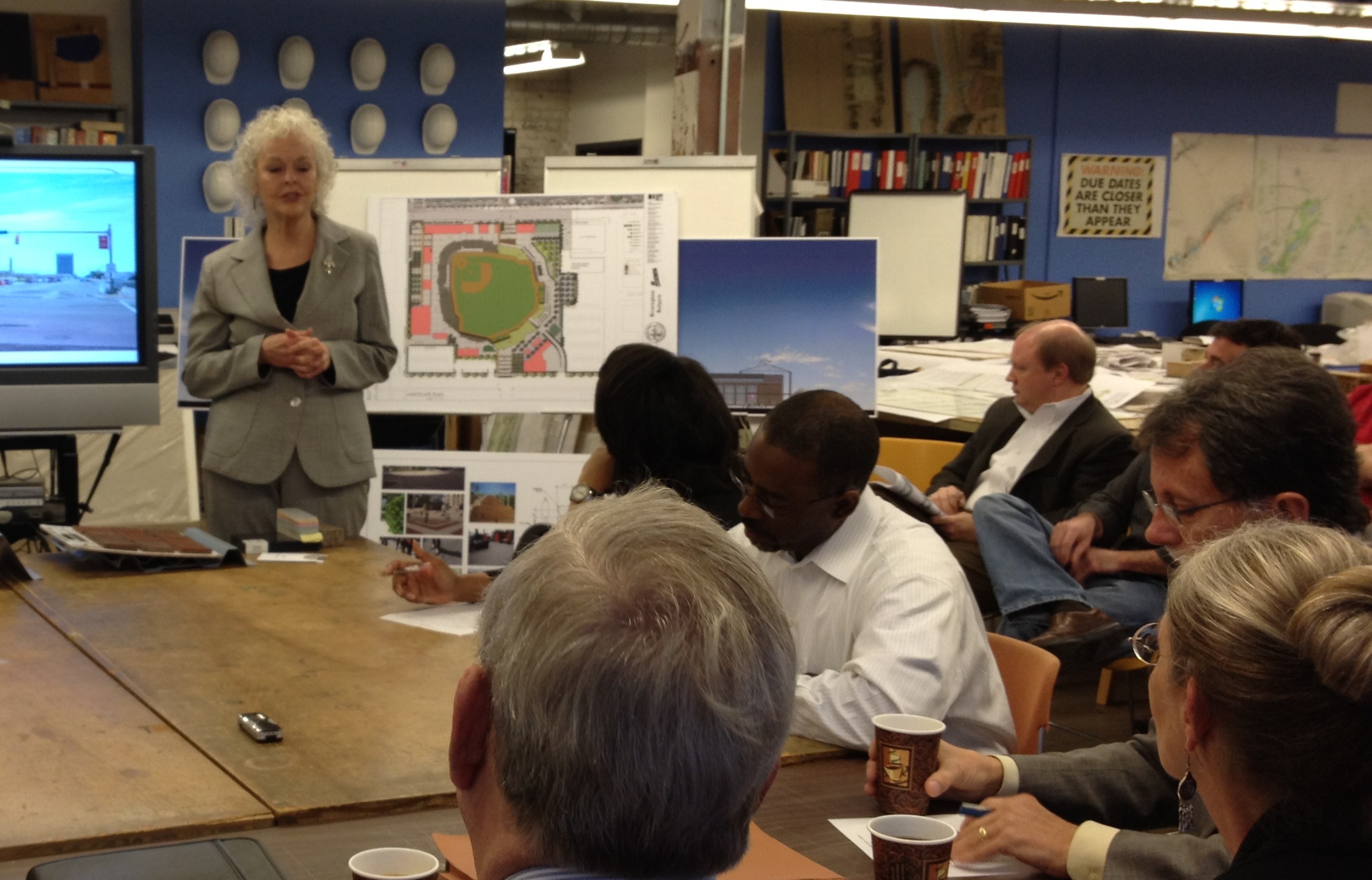
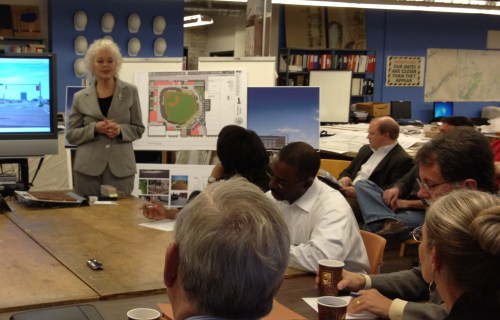
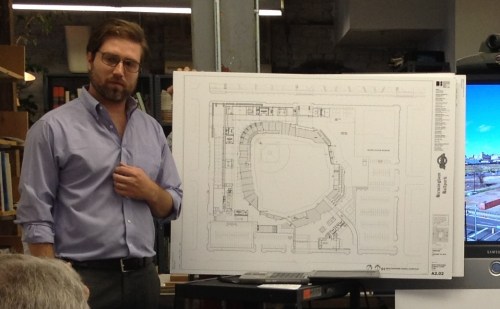
This morning’s Design Review Committee unanimously approved building and landscape design for Regions Field, the new downtown home of the Birmingham Barons baseball team (above, Virginia Williams with the Mayor’s office introduces the project).  Looking closely at the colored plan on the easel above, you can see the baseball diamond oriented for optimum home plate and spectator comfort (shade will fall across the stands at almost all times). In pink are the ancillary elements along the 1st Avenue South edge up top and the 14th Street edge to the left; their character was the subject of most of the Committee’s discussion.
As interactive and porous as possible

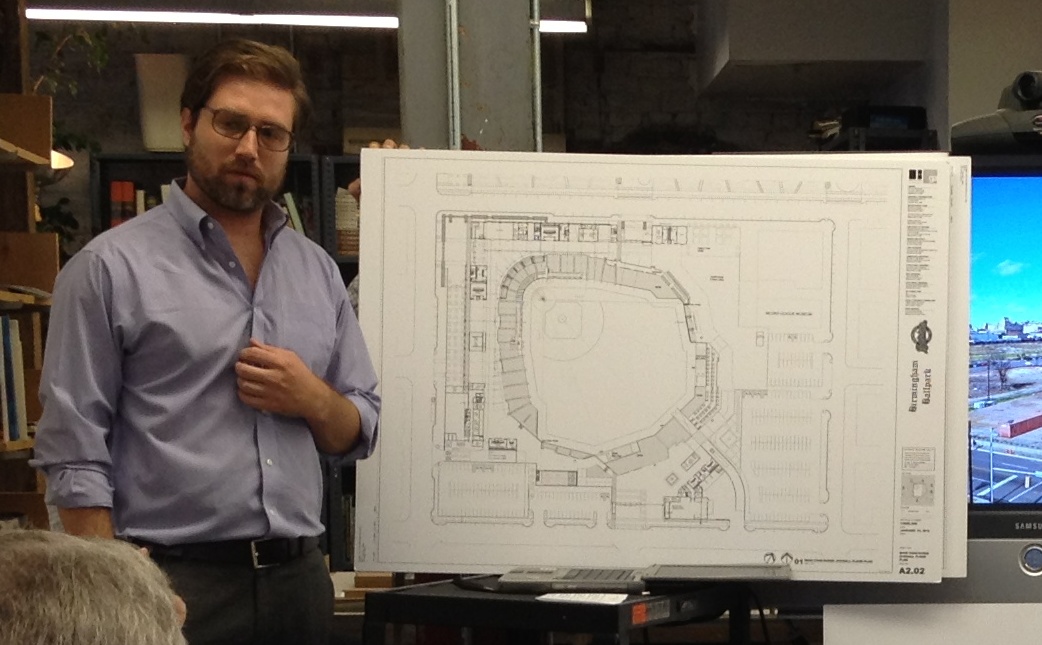
The main floor plan is shown above (Lead architect HKS and local partner GA Studio). Again, 1st Avenue South is across the top (with Railroad Park directly across the street), and 14th Street to the left (west). 16th Street is to the right (east), and 3rd Avenue at the bottom (south). The project takes up 4 square blocks–15th Street and 2nd Avenue are consumed. The main entry plaza is the corner of 14th and 1st Avenue; along 1st Avenue are a ticket office, Barons merchandise store, and ice-cream shop as you walk east towards B&A Warehouse. Those 3 elements will be open daily to the public (and can be entered from the sidewalk as well as from the interior), regardless of whether the Barons are playing. Along 14th Street is a wide landscaped plaza with tables and chairs, that again will be open to the public regardless of the day. There is a connector of landscape walks, green berms, and children’s playground running on the east around the field which will likewise be open to the public at all times as a promenade connecting UAB campus to the Railroad Park.

Still in need of finesse

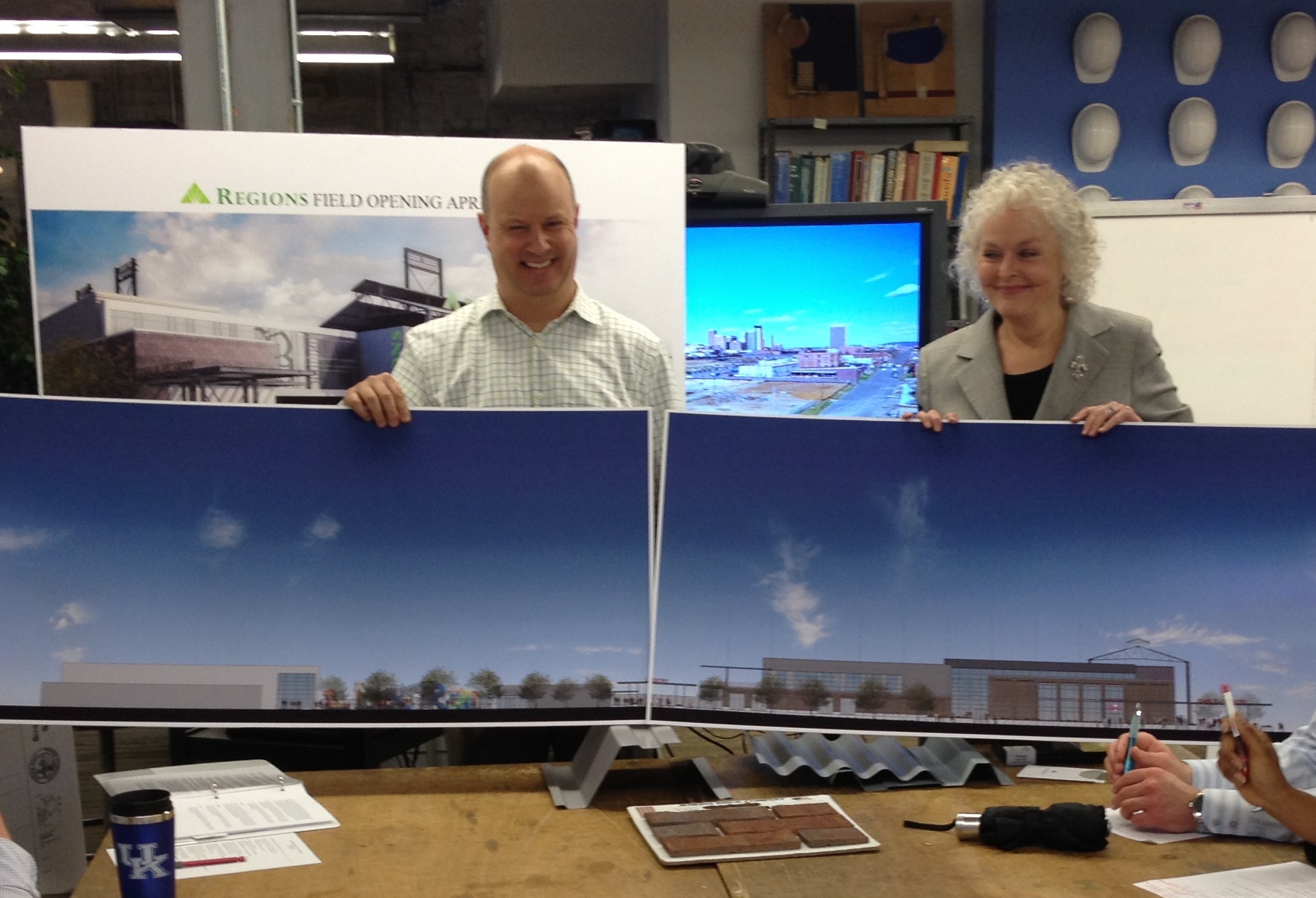
As we’ve noted previously, in an ideal world this project, or part of it, would be located at least 1/2 a block south of 1st Avenue, to allow a good, solid street wall of mid-rise development to take advantage of views and real estate premiums afforded by Railroad Park to the north and Regions Field to the south. Given the situation on the ground, while the designers have done a good job aligning several public elements at the street edge–to activate the public realm–there are still large swathes of one story elements, blank walls, and open space as you move from west to east across 1st Avenue (above, moving from right to left). The Committee asked that the details of the ice cream shop be worked on so that it could help continue the energy of the western part of the building in a more layered, vibrant way. Vacant land just behind B&A Warehouse (far left above) is reserved for future development–both a Negro League Museum and others–and hopefully those will go some way to helping densify that corner of the site.
An active public realm

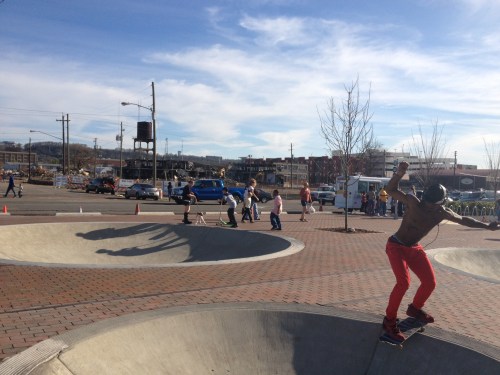
The concern is that the energy of Railroad Park (above, at 15th Street Skate Plaza) won’t be fully leveraged by the edge of Regions Field across the street. Again, given the reality of the siting, the designers have done a pretty good job of incorporating as much as they could–but a ticket office, merchandise shop, and ice cream parlor don’t equate to the potential of continuous mixed-use development with restaurants, shops, and multi-story residences facing the park. The good news is that the baseball park moving downtown is a huge plus; hopefully the surrounding blocks and future development on the site itself will go a long way towards alleviating the current concerns about the edge condition.  We can’t wait for the first game in April 2013.

And just a dozen blocks north...

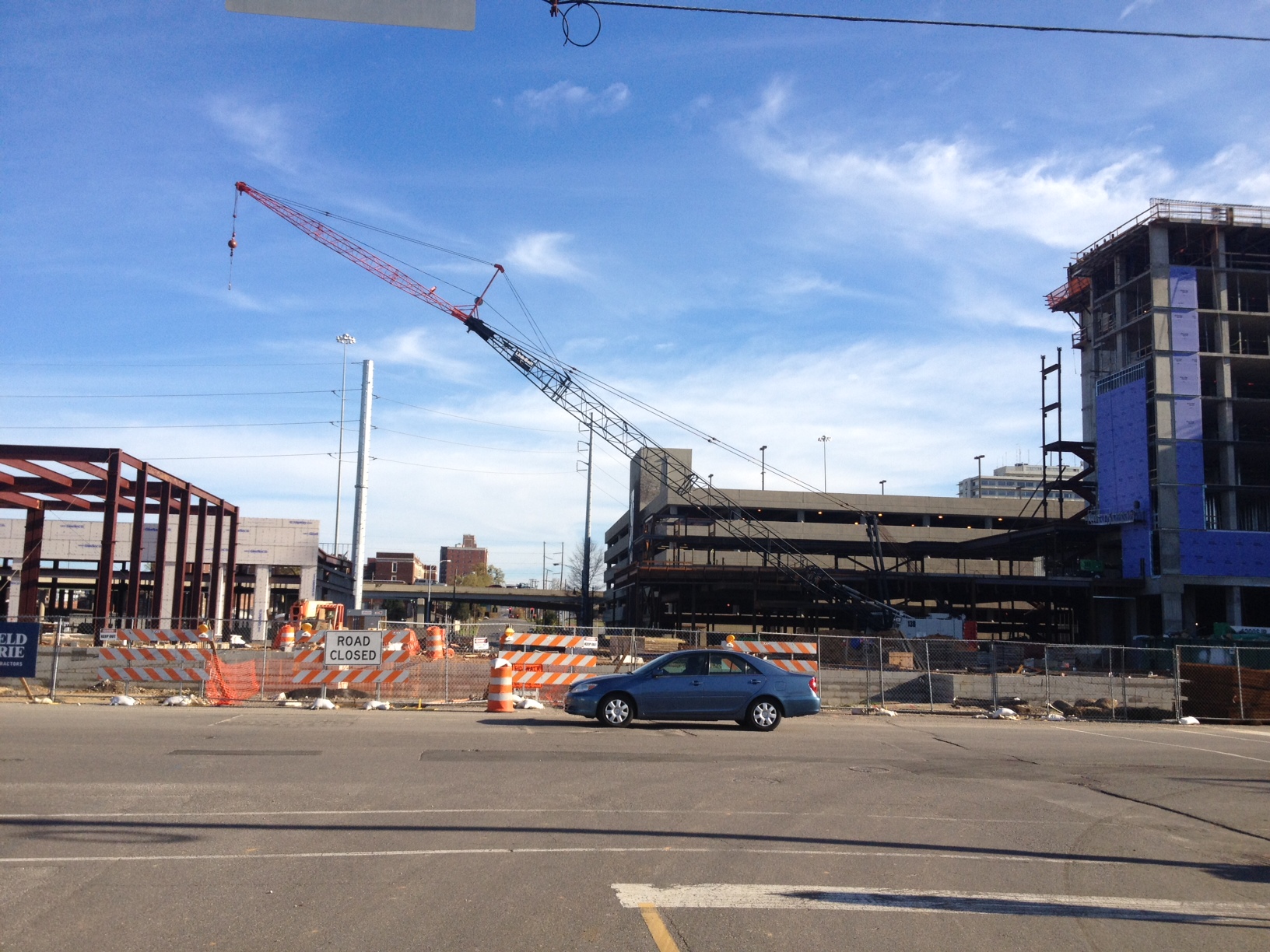
Which brings us briefly to the other big downtown project underway, also on a fast-track–the BJCC entertainment district and new Westin hotel, above. Unlike the construction site for Regions Field, which is even now surrounded by curious pedestrians, housing, Midtown offices and mixed-use, UAB, and Children’s Hospital (all elements which point to an exciting new Parkside neighborhood), the BJCC site has almost no pedestrian traffic, is bounded by interstate ramps, the convention center, and blocks of empty land cleared for future development to the north. It’s easy to visualize Regions Field integrating into the surrounding fabric; at BJCC, the fear is without integration into the rest of downtown and up to Norwood, the project can’t reach its potential. Hopefully the City is working on these connections. I want to go seamlessly from a baseball game, to a restaurant in Parkside, then to get a beer down at the entertainment district–but right now, its unclear how that would happen.
Bringing it down in scale

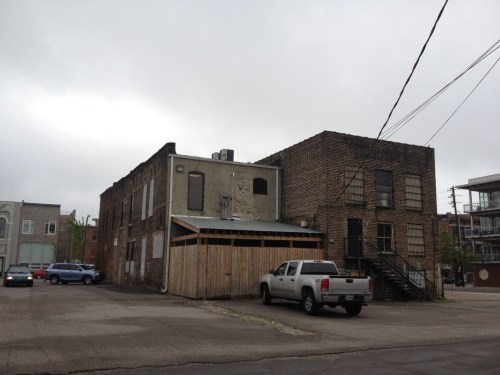
Speaking of beer, approval was also granted this morning to Pale Eddie’s Pour House on the 2300 block of Second Avenue North, to extend their existing rear patio (fenced, above) almost to the alley. We welcome more outdoor space to enjoy a drink downtown, and remind ourselves that while the Westin and Regions Field are exciting, we need to keep nurturing our small, entrepreneurial businesses and places like Pale Eddie’s that help keep our city center unique. Cheers.


Re-imagine

A few days ago TED (the global system of conferences which encourage “ideas worth spreading”) announced its annual TED prize would go not to an individual, but to an idea called City 2.o.  The idea is to create an electronic global platform where citizens around the world can connect with neighbors to re-imagine their cities, using resources from various companies and entities that can help fuel grassroots efforts. Government leaders, planners, non-profits, etc. will all be encouraged to participate in this open-ended dialogue about cities. The beta version of the City 2.0 site is here.

As more and more people realize that cities are indeed our future–and can be models of sustainability, quality of life, and innovation–this prize seems well-deserved. Hopefully all cities, including Birmingham, can re-imagine themselves as what they could be–rather than dwelling on what they’re not. I hope everyone has a great weekend in the city–and let that imagination soar!

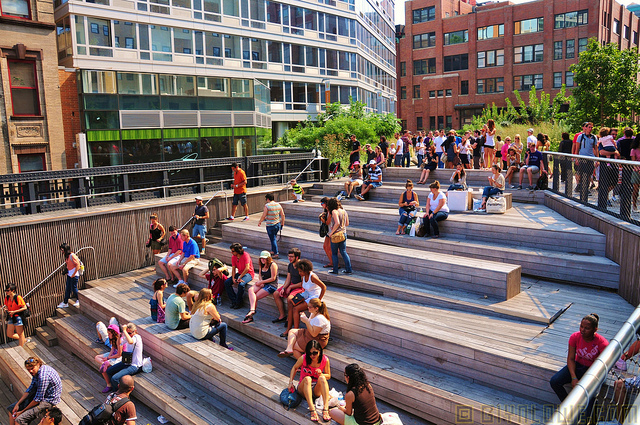
[thanks to Glyn Lowe for the High Line pic]

More investment in the core

A man with a vision

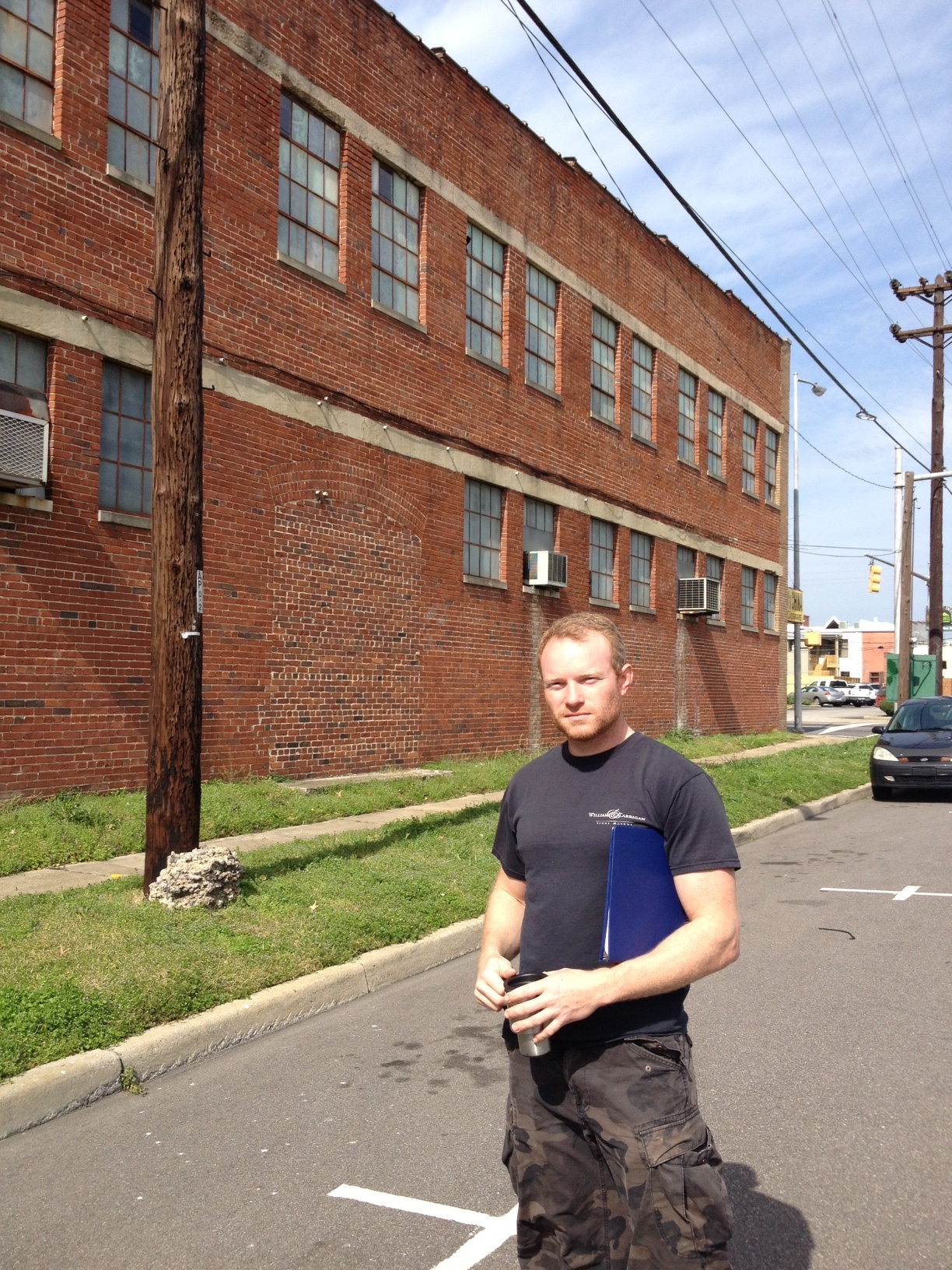
Just as BB’s China and Glassware, located in the former Blackwell Furniture Building at First Avenue North and 25th Street, has decided to close, local urbanite David Carrigan (above) has purchased the building and plans a sensitive, creative renovation. His business–William and Carrigan Stone–will move into a portion of the building, while a stone yard will be located across Morris avenue to the rear.

An otherwise forgotten corner about to come to life

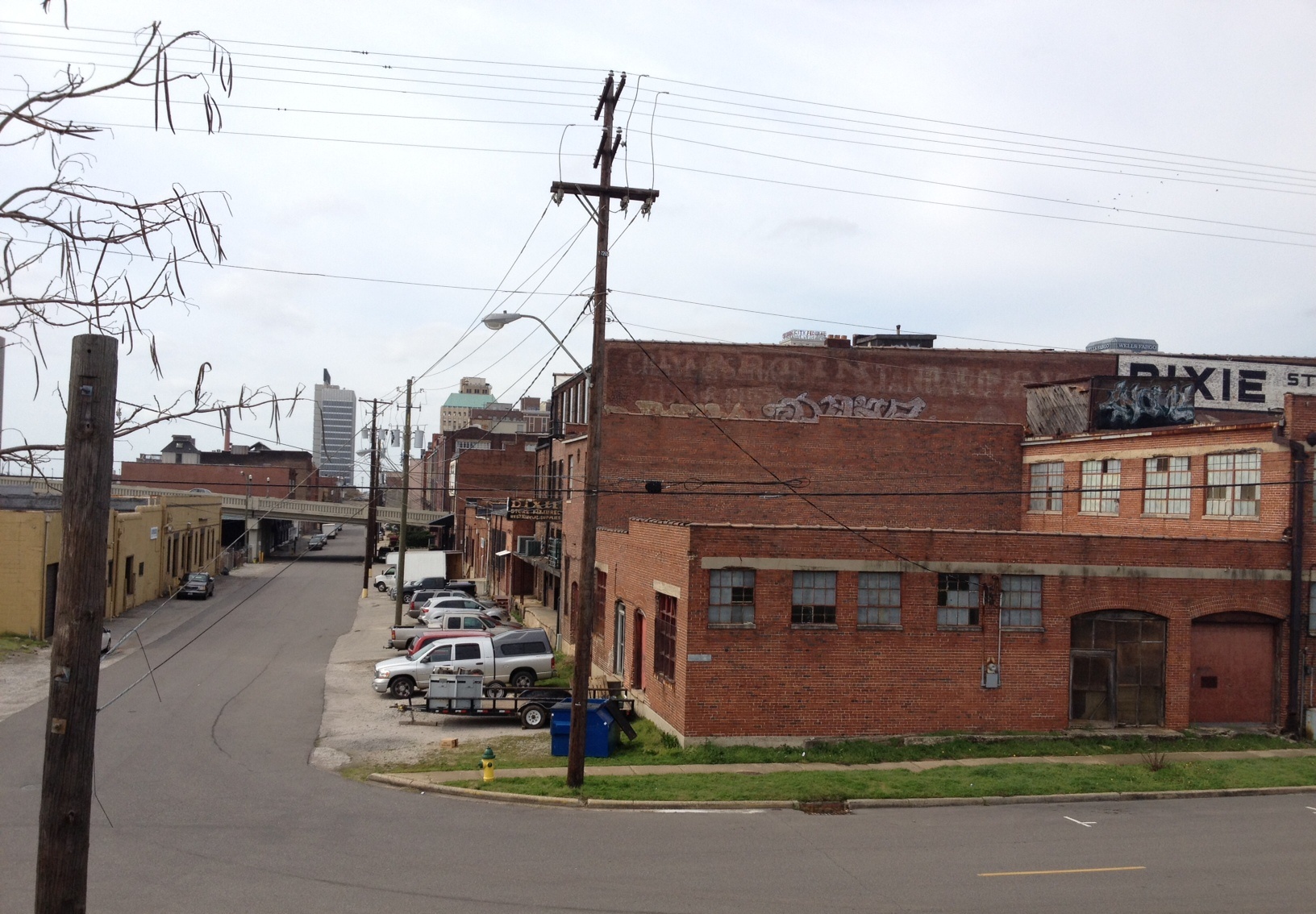
As seen above (looking west on Morris with 25th Street in the foreground), the building has lots of old, warehouse-y character complete with arched openings, original steel frame windows, and a loading area. Carrigan has quite a bit of square feet to play with–and is currently considering potential mixed-uses. Bracketed by an abandoned freeway ramp to the east, and the railroad to the south, the property has lots of potential. The rooftop views are terrific.

I see a bright future

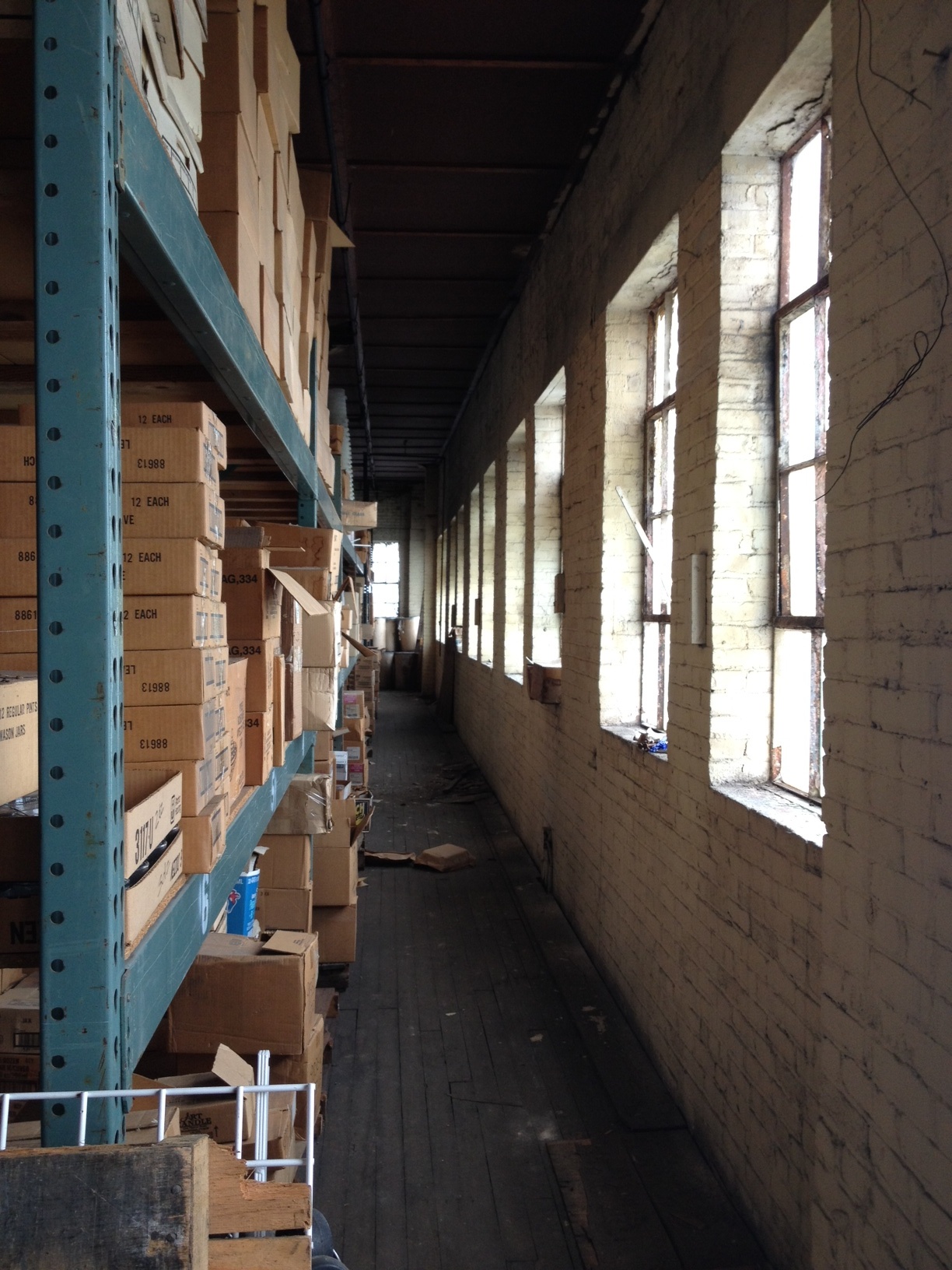
Inside, exposed brick walls, wood floors, timber columns and beams all hint at intriguing possibilities. There’s even a massive painted mural that, once cleaned, will be super-cool.

Moving forward

As Birmingham continues to struggle with limited financing available for private projects, it’s heartening to see a steady stream of small entrepreneurs like Carrigan continue to invest in the downtown core. We eagerly anticipate further news about this project.

Pop-up luncheon

In a word, delicious

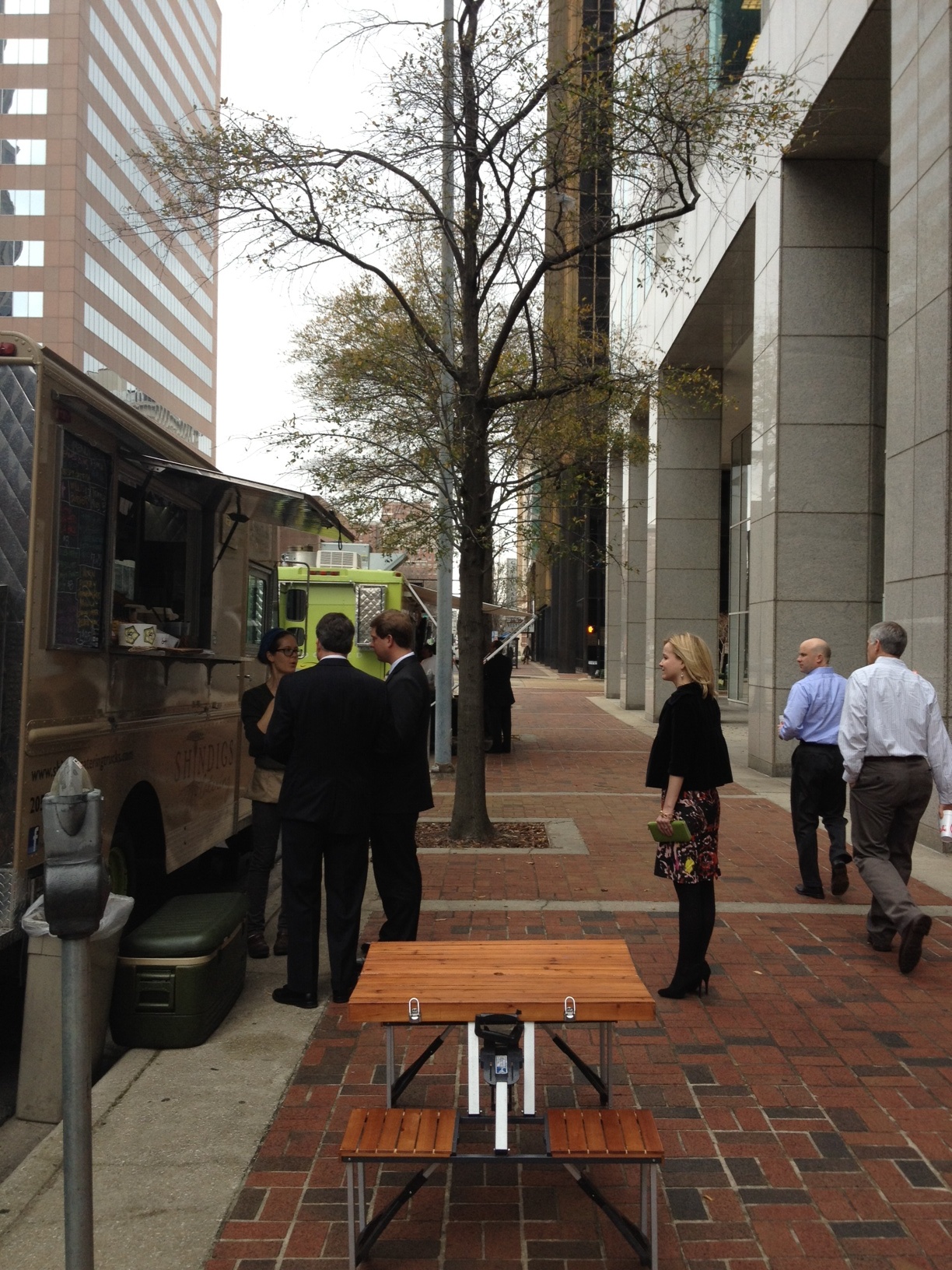
A rainy lunch hour didn’t deter the food trucks from serving eager customers in the downtown CBD today. Above is the Shindigs Catering truck, which has become a favorite across town (grilled prosciutto and fontina  sandwich was fantastic). We appreciated the pop-up picnic tables, some of which were arranged under the covered portico at Wells Fargo on this stretch of sidewalk.

After a brief hiatus for a trip across the border, we’ll be back with more urban news and observations. See you in March!

Keep ’em coming

Hanging with a hipster-ish crowd

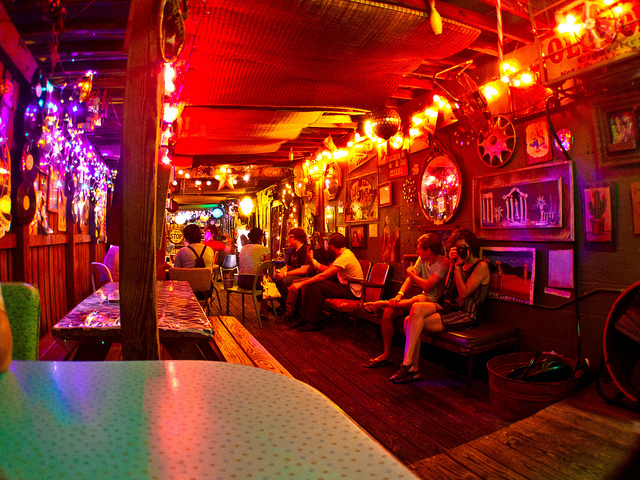
It’s worth reading today’s Atlantic Cities post on Bottletree (above) and the effect its had both on the local music scene, and on its local Avondale neighborhood just east of downtown. In keeping with our recent theme, this is yet another example of why the arts are vital to the City’s development.

And after a steady stream of corruption and bankruptcy articles, it’s nice to see such a positive story in the national press. Thanks Bottletree for all you do for this community!

[thanks to Bradley Nash Burgess for the hipster-ish pic]

Art and its presence

Undercurrent of culture

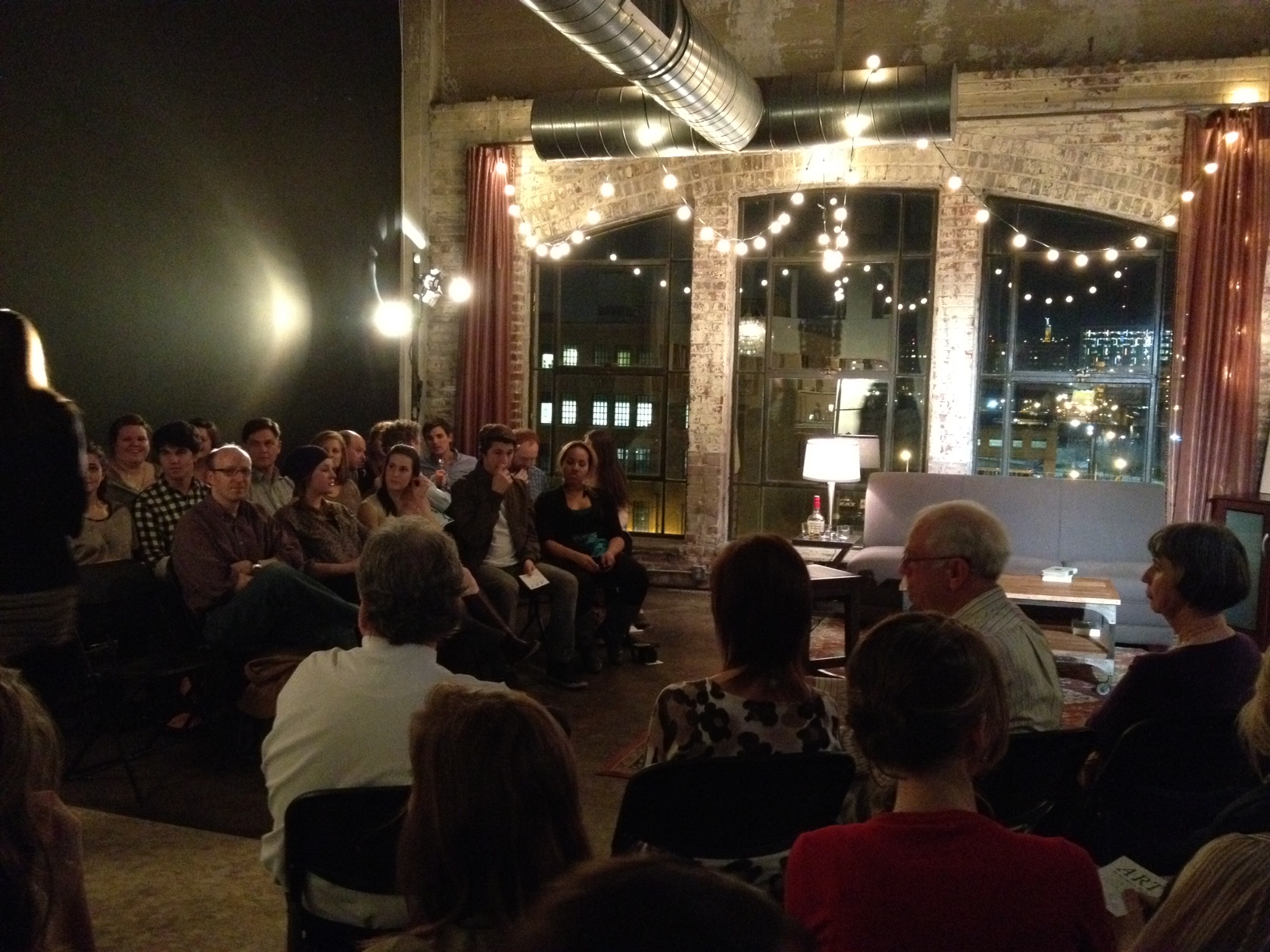
Last night I attended a fantastic production of “Art”, the play by Yasmina Reza, at the Phoenix Building downtown. Produced by A Bryan Photo in their studio loft space (above), the show features 3 fine actors from Los Angeles (tickets may still be available for tonight and Saturday here).

This sort of “underground” art helps make downtowns vibrant and exciting, and is just the sort of artistic energy we hoped would emerge when we developed the Phoenix 7 years ago, with 74 mixed-income units catering heavily to artists. Convinced that this type of loft development could succeed in Birmingham, we’ve seen a truly unique vibe evolve here. We’d love to see more.

Who says a fire stair can't be fun

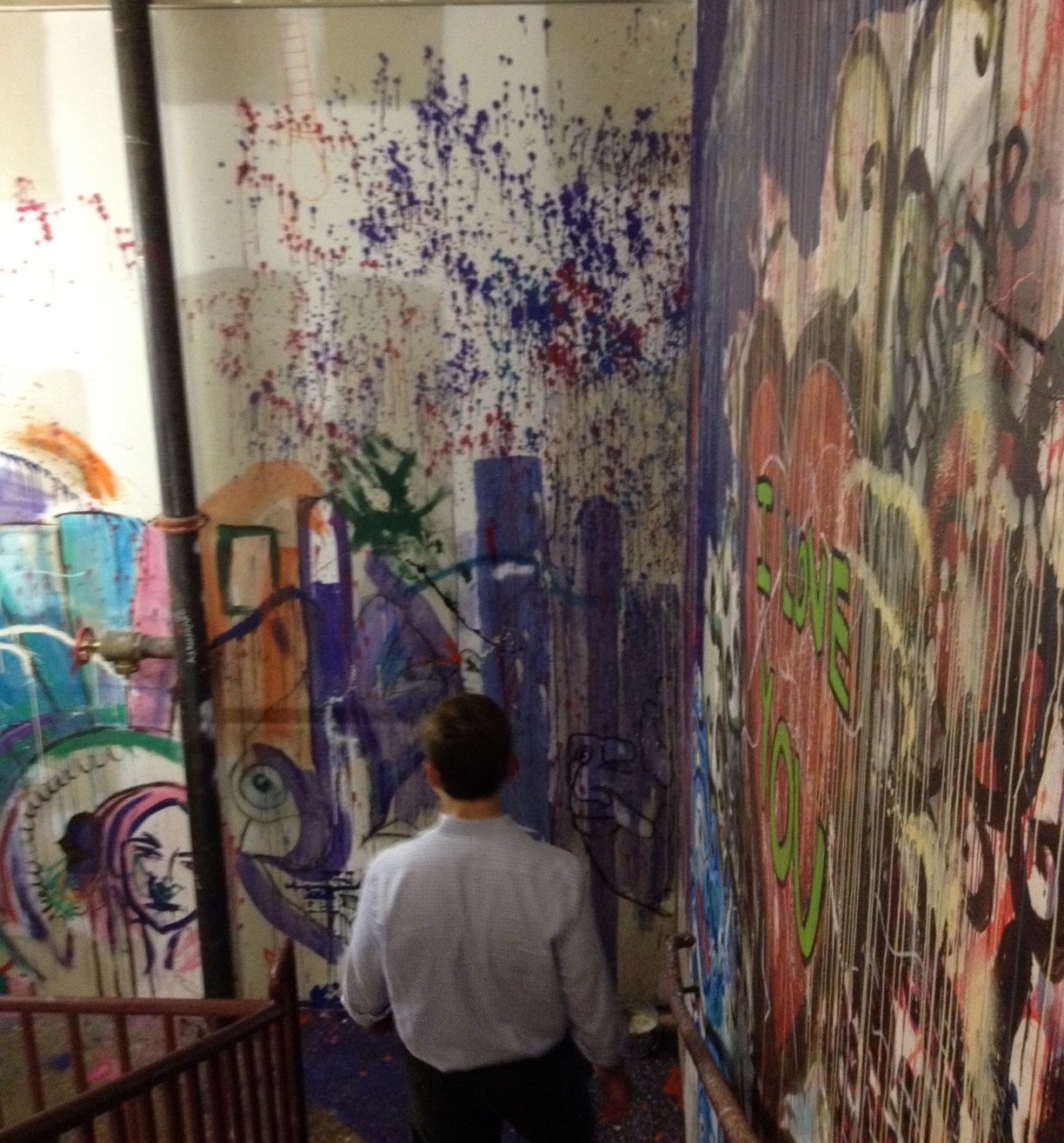
Above is another example of the artsy vibe at the Phoenix–this is one of the fire stairs which is currently a “work in progress”, with various artists from around the building able to add their impromptu expressions to the otherwise utilitarian space. This building project–and the unique energy it’s given to downtown–could not have happened without many financing components, including Federal Historic Tax Credits. Currently, Operation New Birmingham is hoping that the Alabama Legislature will pass a law creating State Historic Tax Credits, a complementary tool that many states already use to help get historic buildings (and their higher costs) renovated. Alabama’s major cities need this law to pass: it will help us all put together more projects, like the Phoenix, that turn vacant historic buildings into revenue producing, tax-paying, vibrancy-building partners in revitalization of downtowns and surrounding historic neighborhoods.

Yes it is--and art expresses the feeling

Let’s get that law passed. And let’s continue to find ways to promote art, and artists, as key elements of improving our urban neighborhoods.


Flash your cash

Lining up to flash the cash

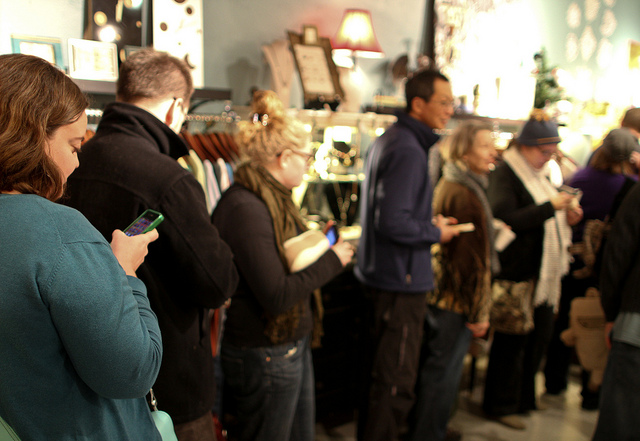
It’s a slow Wednesday; what could be better than hundreds of people descending to spend at a locally-owned store rather than sending hard-earned dollars off to the Walmart corporate HQ in Arkansas?  Cash mobs are popping up across the country as a fun way to help out our beloved independent stores that make cities unique.  Hop onto the Birmingham Cash Mob FB page and put in your two cents for which spots they should hit and join the next mob!

For more on how spending your cash with locally-owned businesses helps improve local economies, check out 3/50 Project. Local indies are often vital to what makes our cherished urban places…cherished. Support ’em!

[thanks to make good, a locally-owned boutique in San Diego, for the pic of a cash mob lining up to buy there recently]


Gown and town

Step in the right direction

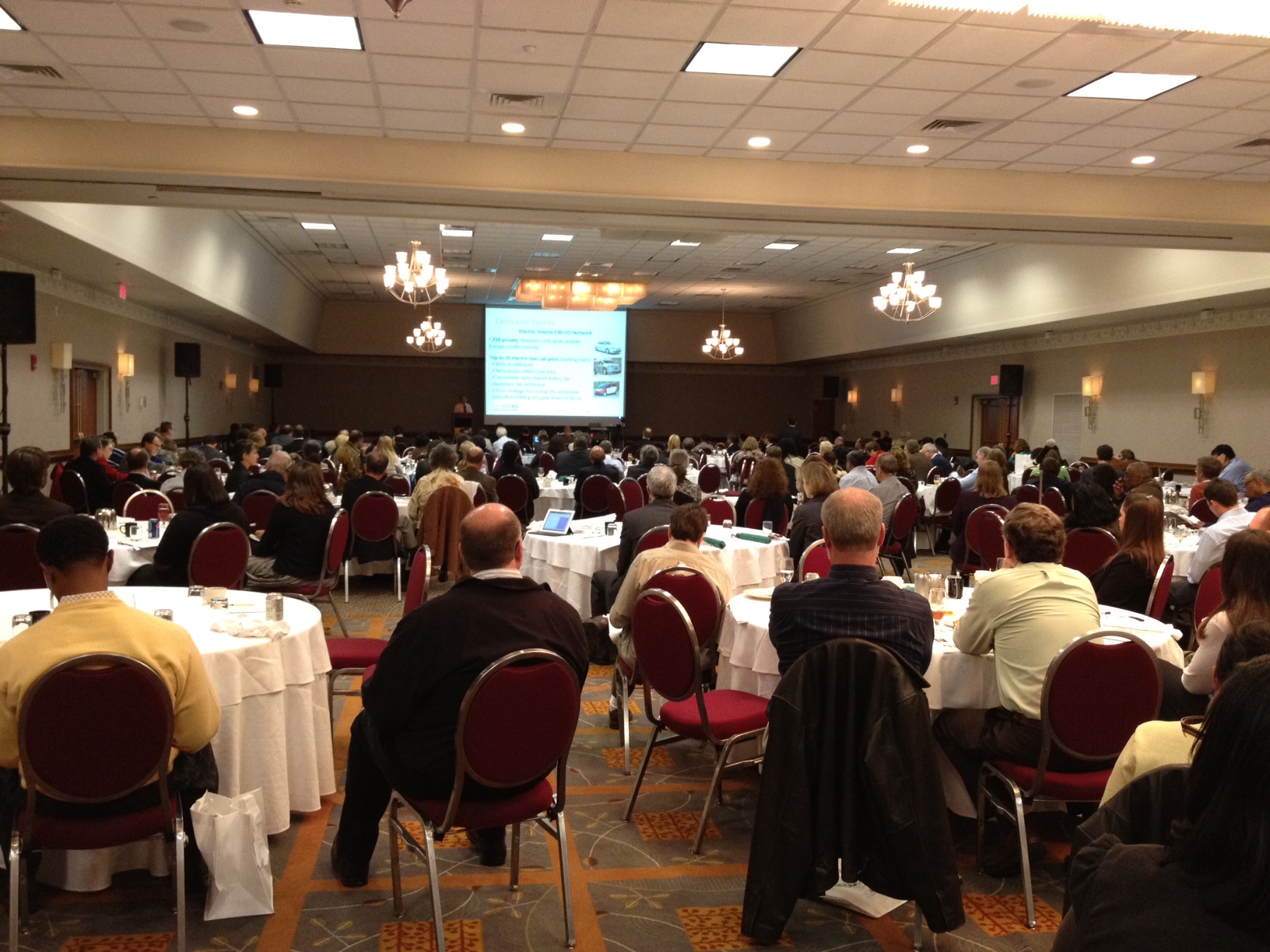
Yesterday the first Sustainable Smart Cities Symposium was held at the downtown DoubleTree Hotel ballroom (above) with over 300 attendees. Local experts on urban growth, sustainability, and health issues (they’re all interrelated) shared the stage with national and international experts such as former Bogota, Columbia mayor Enrique Penalosa to discuss the potential, and challenges, of transforming Birmingham. Penalosa was treated to a bike tour the previous day through downtown and neighboring districts of the City, where he was shocked by the decline and poverty he witnessed (Birmingham News summary here, and News columnist John Archibald’s take here).

The most exciting thing about the symposium: UAB has just established a Sustainability Research Center, bringing together talent from across academic disciplines to tackle urban livability, design, and health issues in collaboration with the City and community. This sort of “town gown” collaboration is very welcome, and should benefit all of us.

Appeals to a mixed, urban demographic

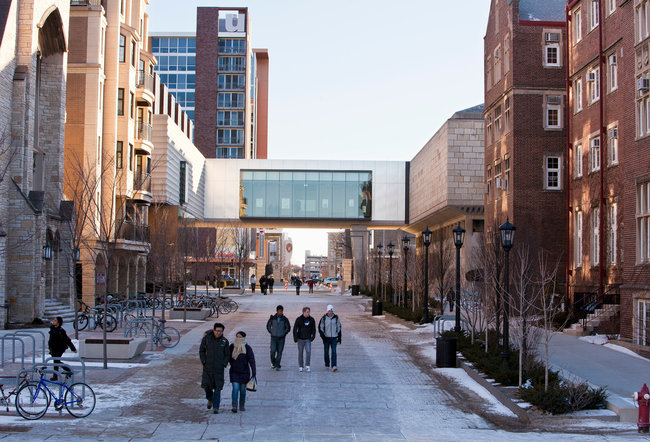
Speaking of town gown collaboration, shown above is the University Square mixed-use development adjacent to University of Wisconsin (Madison), one of a string of well-planned developments that have completely transformed the East Campus Gateway into the university. A combination of university, city, and private dollars have created a pedestrian-friendly, dense environment where students, faculty, retailers, and urban professionals all mingle together. The New York Times profiled this project here. This is a good example of the impact a university can have on the surrounding built environment, with careful planning and collaboration. There’s no reason Birmingham can’t become the “Madison of the South”. UAB’s new Center is a promising start.

Still enjoyable even in freezing temperatures

The 7-block Gateway, lined with dorms, classroom buildings, retail, and market-rate apartments is shown above. If students and citizens of Madison stroll this place in the long winter months, just think of it’s equivalent in sunny Birmingham…

[PS On a tangent–the DoubleTree hotel needs a good designer to completely overhaul its public areas. For such a well-located, popular hotel its interiors are behind the times.]

[thanks to beautifulcataya for the U Square pic, and the NYT for the Gateway pedestrian pic]


Art and its absence

Validating our humanity on various levels

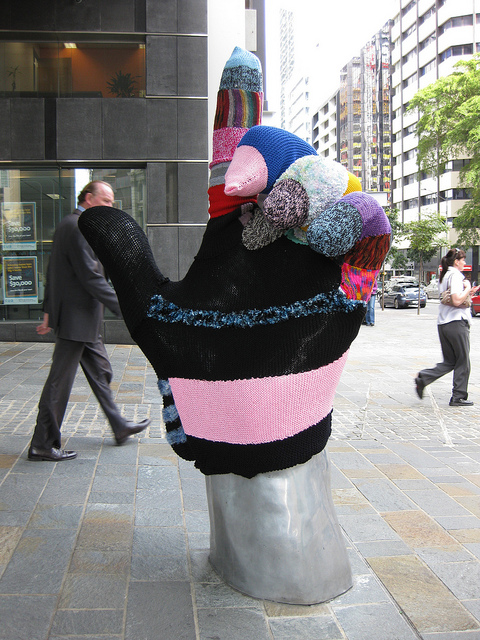
As we’ve discussed before, Birmingham has a poor record of supporting public art. While other cities large and small use public art as a routine component of urban revitalization, we have no comparable strategic program here (pictured above is “Chat” in downtown Brisbane, Australia by the sculptor Sebastian di Mauro; the whimsical knit bombing is by others). The absence of a good public art program is ironic given the local artistic talent that the City has, as well as  the ability of institutions like UAB and the Birmingham Museum of Art to attract all sorts of international talent to their stages and walls on a regular basis.

Long overdue

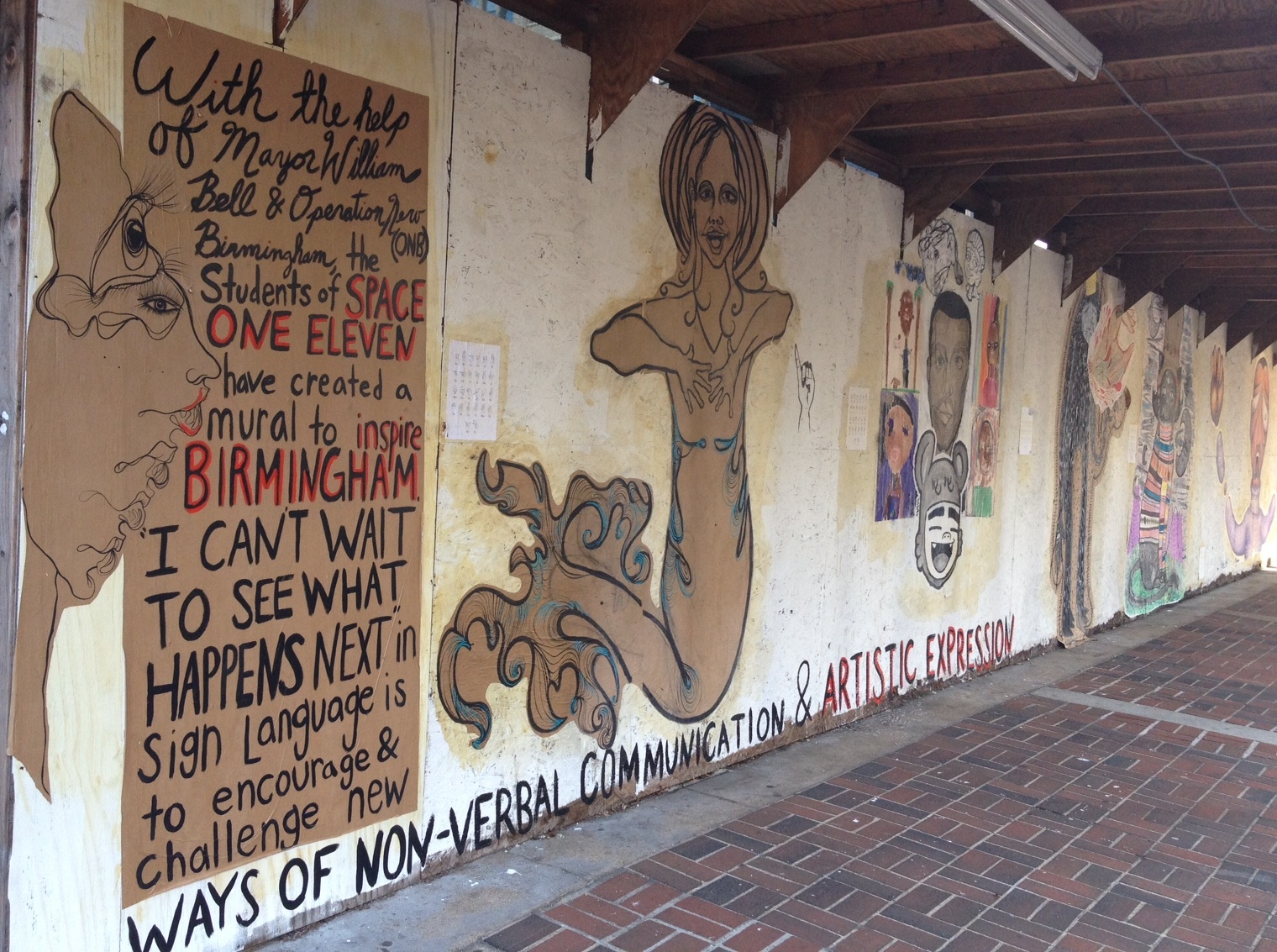
One of our readers alerted us last week to the public art project (above) at the base of the Brown Marx Building. For several years ugly, protective scaffolding has been erected around this large, historic vacant building at the corner of First Avenue North and 20th Street (several plans for mixed-use conversion over recent years have fallen through). Art students with local visual arts non-profit Space One Eleven were sponsored by the City and Operation New Birmingham to create art across the long expanses of plywood. It’s low on budget but high on creative energy.

Now that's attention to detail

Particularly satisfying was the portrait of Mayor Bell (detail, above), whose fingernail reflects an image of the downtown skyline. We love that.

Feast for the soul

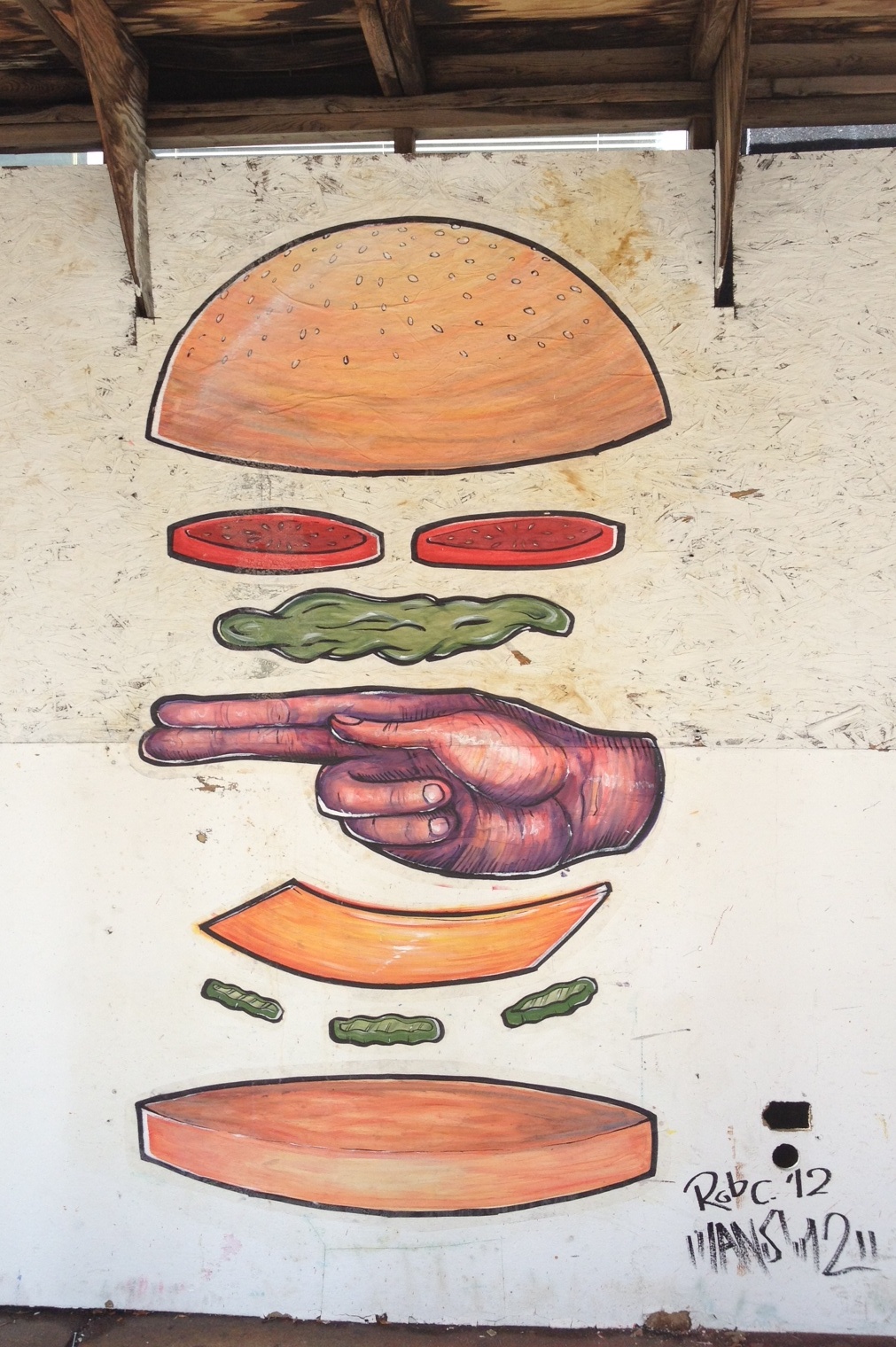
For a major building to present such a forlorn aspect to such an important public intersection is disheartening. The art project goes some way to brightening this condition (and will soon by joined by a pilot project, also sponsored by the City and ONB, to install more art in vacant storefronts along 20th Street). Demonstrating the power of temporary public art is a good start towards implementing a permanent public art program in targeted areas of the City.

Looking better

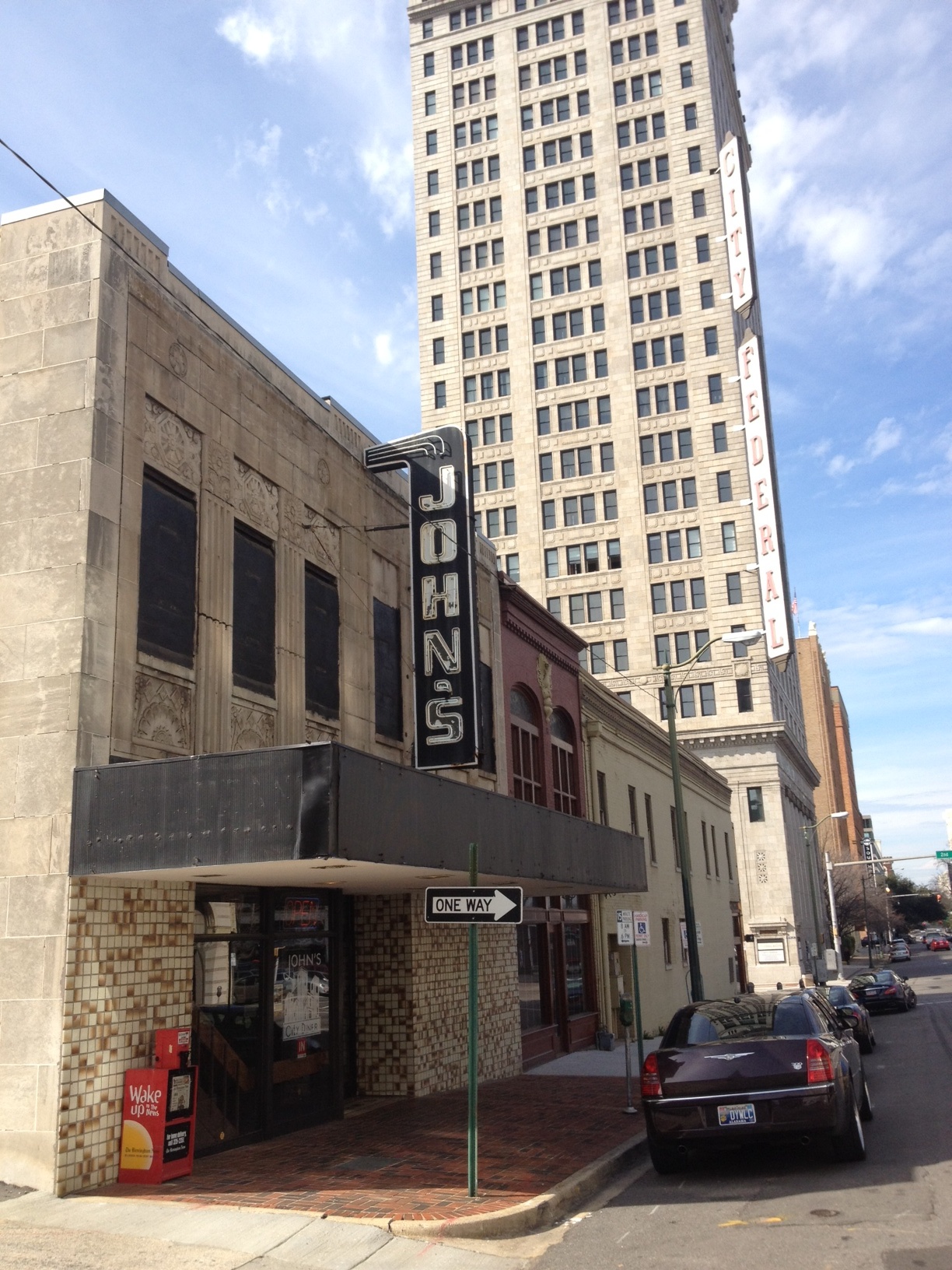
That last image of the burger-for-the-soul brings us to a nice tangent–John’s City Diner (above), one of downtown’s oldest extant restaurants, and around the corner from the Brown Marx. The facade experienced an unfortunate renovation–guessing the early 1970’s–with tile and metal siding. Over the last weeks the owners have been partially renovating the frontage, revealing the beautiful art deco detailing still remaining at part of the top floor. Fingers crossed that the canopy and storefront can also be renovated. And that the iconic neon sign can remain lit for many more decades to come.

[thanks to trowzers for the Brisbane shot]